By Luke Frazier
The Island News
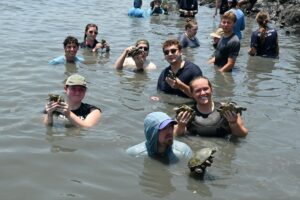
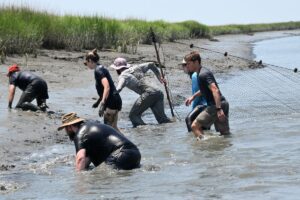
The heat was thick in the tidal creeks on St. Helena Island on the morning of Saturday, June 13. The pluff mud was thicker.
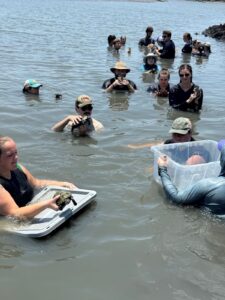
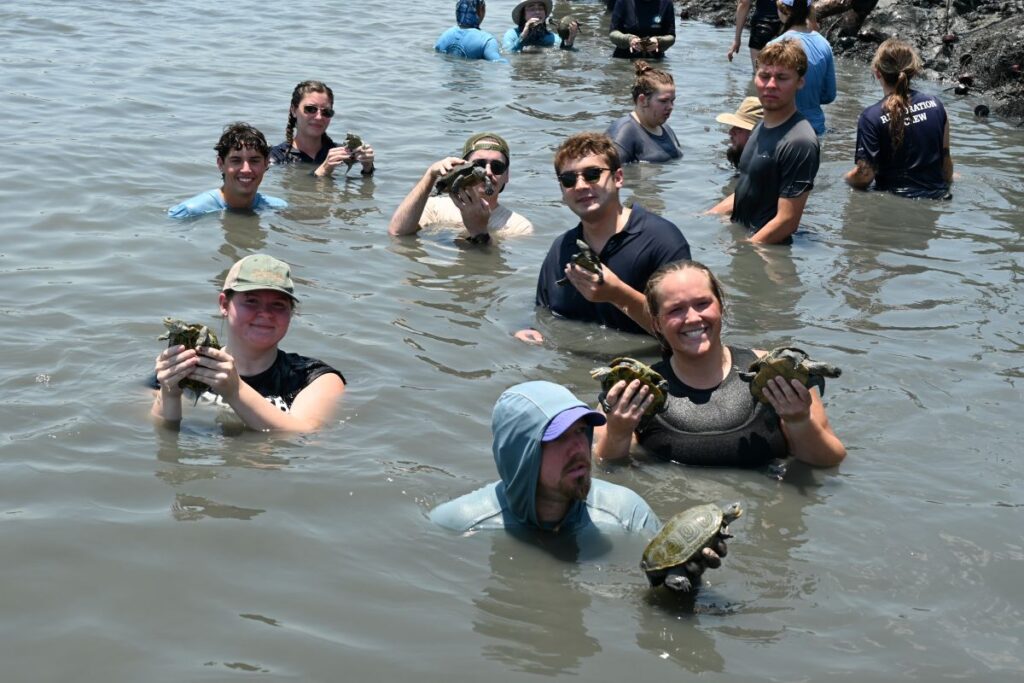
Neither was any kind of deterrent for the more than 50 volunteers who came to take part in capturing diamondback terrapins as part of the field work for an ongoing conservation study.
The study includes capturing, measuring, weighing, and tagging the turtles — all done with the necessary permit. The purpose behind these activities is long-term monitoring of diamondback terrapins, a state designated “high priority” species for conservation due to its declining population. These little creatures are vitally important to our local salt marshes and creeks; a view offered as an absolute fact by everyone asked.
This vocal pro-turtle advocacy crew included Jordan Gray of the Turtle Survival Alliance (TSA), a global organization based in Charleston. Sporting a scruffy look and a cap imploring all to “Drink Beer — Save Turtles,” which, it turns out, is a TSA fundraising venture that partners with breweries across the country, Jordan was clear about why he thought what was happening was borderline sanctified.
“One of the things is you get in the water, actually in there in the mud with these terrapins,” he said. “You get a whole different appreciation for the coastal marshland that’s all around us. By immersing yourself in it you feel so much more at one with nature.”
Gray, a self-described “turtle nerd” since he was 4 years old, a badge of honor worn by many on this day, continued musing about the power of looking this unique and beautiful animal in the eyes, the only turtle that lives exclusively in brackish habitats throughout the entire world.
“Hundreds of millions of years in the making,” he marveled, “and we get to still enjoy their presence today.”
It was threats to that enjoyment that brought together study partners that include Lowcountry Ecological LLC, the Port Royal Sound Foundation, the University of South Carolina Beaufort, the South Carolina Department of Natural Resources (SCDNR), Coastal Expeditions of Beaufort, the Fripp Island Resort Nature Center, and the Turtle Survival Alliance.
Chris Kehrer of the Port Royal Sound Foundation was busy orienting the volunteers on the day’s activities and shouting instructions as the time approached to jump in the creek. His booming voice contrasted with his gentle demeanor, testifying to the seriousness of saving turtle lives.
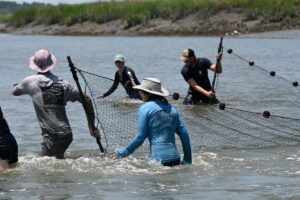
Kehrer pointed out that terrapins were hard to capture, even with the special 40-foot nets volunteers would be holding while walking through the water (and occasionally slipping in the fragrant mud) while others splashed directional encouragement for turtles seen peeking from the water.
“Most people interact with [diamondback terrapins] when they’re crawling in their backyard if their yard is by a marsh,” Kehrer pointed out, “and they’re seeing the nesting females there. They often don’t see them in the marshes themselves.”
On this day, Kehrer was helping volunteers get up close and personal with the turtles who are facing threats that include boat propellers, poachers, crab pots, coastal development, and predators that enjoy turtle eggs. Not to mention vehicles traveling on Sea Island Parkway that sometimes run over female terrapins seeking higher ground to build nests.
“Their eggs can’t be inundated with water because they’re semi-permeable,” Kehrer explained, “So they go into an upland area, and causeways are perfect because they’re like man-made dunes in the middle of the marsh.”
Ryan J. Hanscom was also concerned about turtle mortality on Sea Island Parkway. Hanscom is Assistant Professor in the Department of Natural Sciences at USCB. His interest is in using data that documents what population is taking the brunt of the road hits as a spur to action.
“Maybe [we can] build something under the road or use other types of road barriers to prevent females from crossing,” he said before continuing, “If we can show that this population of females are getting hit, and have a declining population, that might give us some incentive to do some more things on the road.”
Those other things might include flashing signs, walling systems to funnel female terrapins into specific crossing areas and simply increasing signage.
For State Park Ranger John Alexander, the ongoing study is important regardless of any specific actions that result from it.
“There’s a lot of animals out there that don’t get the publicity they deserve,” Alexander reasoned, “I think by us doing this study and getting out information out in the public a little more it will make people more aware. Diamondback terrapins are the most unique turtle we have in the Lowcountry for sure.”
For some volunteers in the crowd the issue elevates further to include conserving all animal life. Hunter Balog came down from the Riverbanks Zoo and Garden in Columbia.
“Any animal provides an ecosystem service,” she declared, “You might not be directly affected by it, but it affects different levels of an ecosystem things you might enjoy, like fresh air and trees and plants. So caring about every single animal is important.”
On this day it was the diamondback terrapin who was in the spotlight. This is the third year of the study and about 100 turtles so far have been marked, an impressive 37 more on this Saturday. Twenty-four of them had not been previously caught, and 16 of them were females that were considered “gravid,” or carrying eggs internally.
Perhaps even more impressive was the enthusiasm and love the gathered had for the diamondback terrapin as a part of this occurring world. There may be environmental problems wherever you look, but in this small cluster of tidal creeks and rank-smelling mud, affirming environmental conservation was a cause for celebration.
Luke Frazier is a writer and award winning media producer who moved to the Lowcountry in 2024. He runs NOW Communications and can be reached at nowandfuturecomms@gmail.com.