
Agenda fight opens tense meeting; members later reject immediate release of investigation report
By Delayna Earley
The Island News
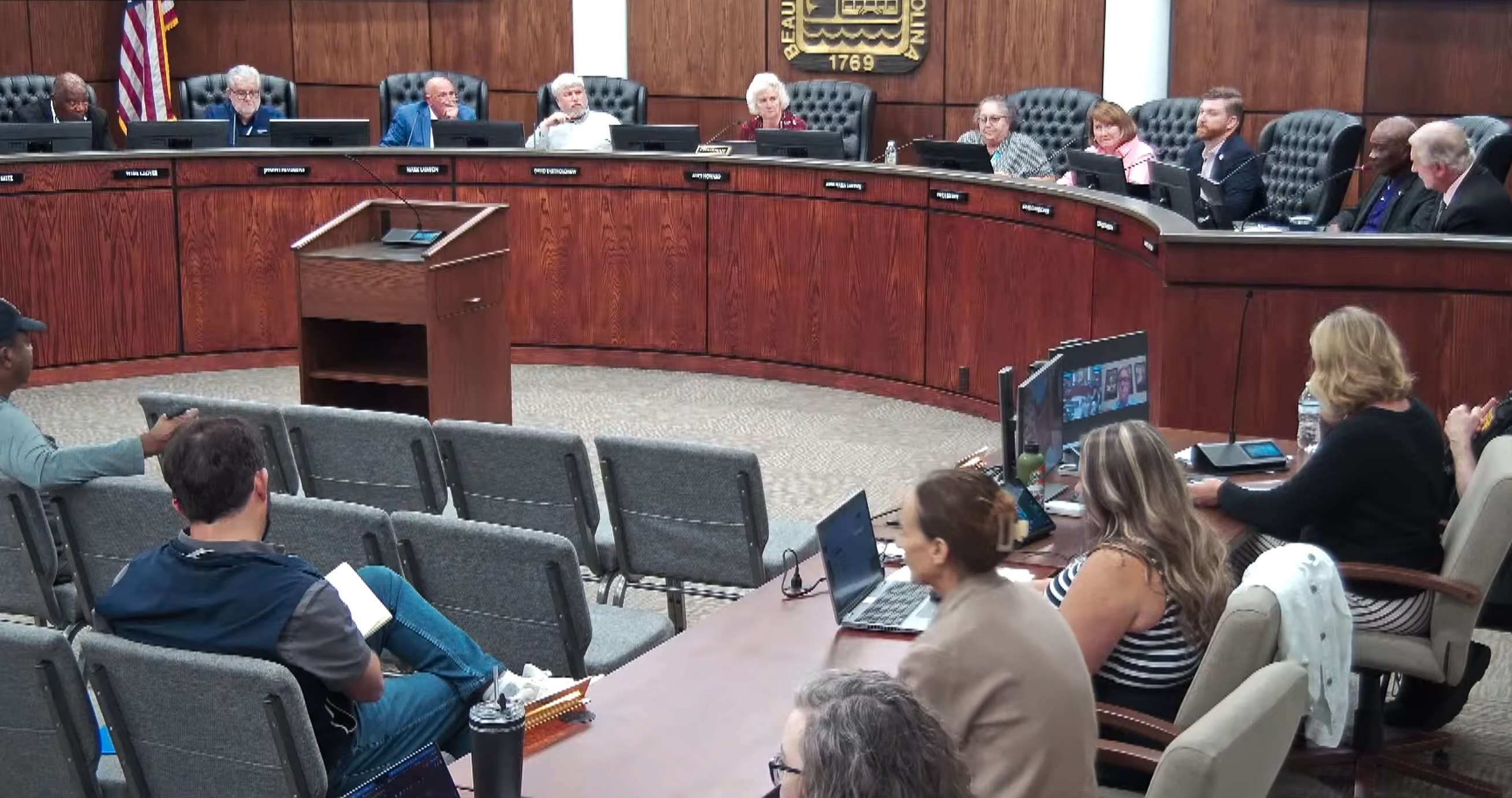
Beaufort County Council had barely begun its meeting Monday night when members were already discussing whether they might simply go home.
An effort to add two discussion items to the Oct. 12 agenda set off a tangle of votes, procedural questions and conflicting explanations about how many members needed to agree before council could proceed.
Councilman Logan Cunningham pointed out that the seven members who wanted the additional discussions could block the original agenda by voting against it.
“So the seven people that want to discuss this today, if they vote no, then the agenda is not approved for today,” Cunningham said.
Earlier in the procedural debate, he summed up the possible outcome: “All right, so we can all go home.”
Council ultimately stayed and conducted its business. But the disagreement that complicated the opening returned before adjournment, this time with pointed accusations, an argument over contacting outside counsel and a failed attempt to immediately release an investigation report.
The Quick Group inquiry dominated both ends of the meeting, exposing disagreements over council’s next steps and whether County Administrator Michael Moore should respond to the findings before the public sees them.
Seven votes, but no amended agenda
The opening dispute began when Councilman Lawrence McElynn asked to add discussions seeking timelines and action plans for the Quick Group report and a proposed change that would have the county attorney’s office report to council rather than the administrator.
McElynn said he was seeking discussion, not legal advice that would require an executive session.
Seven members supported the additions. Chair Alice Howard, Vice Chair Anna Maria Tabernik, Paula Brown and Gerald Dawson opposed them.
But seven votes did not settle the matter.
Council worked through competing explanations about whether a simple majority was sufficient or a supermajority was required, eventually proceeding under the interpretation that approving the agenda with the additions required eight votes.
The amended agenda was declared failed.
That left another question: Would enough members approve the original agenda to allow the meeting to continue?
The original agenda needed six votes. Cunningham noted that the seven members who supported the additions could instead vote against proceeding without them.
Council ultimately approved the original agenda 7-4. McElynn, Cunningham, David Bartholomew and Joseph Passiment voted against it.
The meeting moved on. The investigation did not stay out of it.
‘A damn good job of arguing with me’
As council approached adjournment, McElynn returned to the subjects members had declined to add, asking leadership for a timeline and warning against allowing them to “drift off into Never Neverland.”
His request reignited the argument, and this time, the discussion moved beyond parliamentary procedure.
Tabernik challenged McElynn’s contact with outside counsel, saying council had agreed that communications with the firm should go through the chair. McElynn said he had been directed to contact the attorney about the proposed reporting change.
When Tabernik said she was not going to argue with him, McElynn replied, “Well, you’re doing a damn good job of arguing with me.”
Howard intervened, but the larger dispute over releasing the investigation report continued.
Fairness to Moore or fairness to the public?
Howard said Moore received the report Oct. 6 and needed an opportunity to respond to its recommendations before public release. She initially pointed to council’s next regular meeting, Oct. 26, for further consideration.
“I don’t think that is fair to our administrator to release it today without him being able to publicly address the recommendations in it,” Howard said.
Bartholomew challenged that reasoning.
“It’s not fair to the public that we spend that much money on it,” he said.
He described the report as 15 pages and questioned the need for additional preparation time.
“It’s not rocket science,” he said.
Councilman Tom Reitz pressed Howard on council’s earlier commitment to make the findings public. When Howard said Moore had not prepared written comments, Reitz questioned how she knew.
“Did he report that to you or are you just making it up right now?” he asked.
“No, I’m not making it up. That’s insulting,” Howard responded, saying she had spoken with Moore that day.
Dawson urged council to give Moore time to read the report, digest it and prepare to answer questions. Councilman Mark Lawson also supported eventual release but wanted Moore to have an opportunity to respond first.
Tabernik supported disclosure while questioning whether investigators had completed the assignment council gave them.
“We told the public we’d release it. The public paid for it,” she said.
She said council had requested a data-driven inquiry into four specific areas and that the work was not complete to her satisfaction. Howard said a supplement was expected but had not yet been received.
No completion date for that additional work was established during the exchange.
Council commissioned the inquiry earlier this year to examine departments and personnel overseen by Moore and their compliance with county policies, procedures, laws and ordinances. Council unanimously authorized an outside inquiry June 1 and agreed June 22 to hire The Quick Group, LLC. The Island News’ earlier reporting and the county’s June action summary document those decisions.
Bartholomew moved Monday to release the findings immediately, with Cunningham seconding.
Cunningham also questioned whether every council member had read the entire report before taking a position on its release.
The motion failed 5–6.
Tabernik, Bartholomew, Cunningham, Passiment and Reitz supported immediate release. Howard, Brown, Dawson, York Glover, Lawson and McElynn opposed it, according to the county’s vote record.
‘Why is that secretive?’
Even after that vote, questions about access to the report produced another tense exchange.
When Cunningham asked who else had seen it, Tabernik revealed that a paper copy had already been provided to the Beaufort County Sheriff’s Office at the sheriff’s request. She said the sheriff requested it in connection with another matter, that it had been provided shortly before the meeting and that the disclosure had been advised by the attorney.
Reitz questioned why council had not been told the report had been provided to the Sheriff’s Office.
“Listen, I appreciate and respect law enforcement,” Reitz said. “My only question is why would council not be advised to that at that moment? I’m not saying not to release it, but why is that secretive?”
“It’s not secretive. It happened right before this meeting,” Tabernik responded.
Tabernik rejected the suggestion that the exchange had been secretive and said she would not impede a law-enforcement investigation. The discussion did not establish the nature of that investigation or its connection to the report.
Moore said he had not shared the report with staff. He said consulting some employees would help him respond to policy recommendations, but he would wait for direction before doing so.
He indicated he could provide his written response by Oct. 19.
Before adjourning, council settled on meeting again that day after its scheduled committee meetings, moving the discussion forward from Oct. 26.
Council finished the night with another meeting to attend, and without approving immediate public release of the findings.
Delayna Earley, who joined The Island News in 2022, formerly worked as a photojournalist for The Island Packet/The Beaufort Gazette, as well as newspapers in Indiana and Virginia. She can be reached at delayna.theislandnews@gmail.com.