
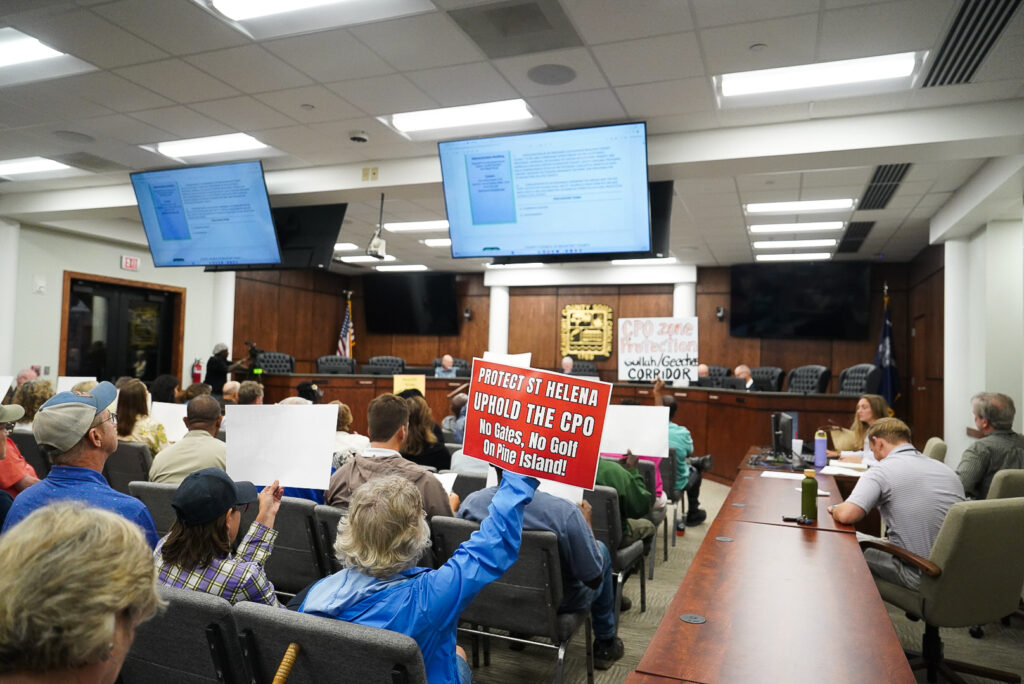
Planning Commission unanimously opposes removing 502 acres from St. Helena Island protections after lengthy public hearing
By Delayna Earley
The Island News
The Beaufort County Planning Commission unanimously recommended denying the latest attempt to remove approximately 502 acres of the Pine Island property from St. Helena Island’s Cultural Protection Overlay following a lengthy public hearing Monday night.
The vote came nearly three hours into the Oct. 5 meeting, after county staff recommended denial, representatives for Pine Island Property Holdings argued that the request should be evaluated as a straightforward zoning map amendment and resident after resident urged commissioners to preserve the CPO.
The commission’s recommendation will be forwarded to Beaufort County Council and its Natural Resources Committee. County Council has the final authority to approve or deny the requested zoning map amendment.
Public hearing formally added
Before considering the application, commissioners unanimously amended the item to formally designate the proceeding as a public hearing. The change came after the county attorney recommended clarifying the agenda, even though the meeting had already been advertised as a public hearing.
The clarification resolved a discrepancy noted before the meeting. A sign posted outside Pine Island in mid-September advertised an Oct. 5 public hearing, and a legal notice published Sept. 20 said the commission would receive public comment on the application.
The commission’s formal agenda, however, listed Pine Island as an action item without specifically identifying it as a public hearing.
Commissioners ultimately received more than 40 minutes of public comment on the request.
The application, filed by attorney Kevin E. Dukes on behalf of property owner Elvio Tropeano and Pine Island Property Holdings LLC, asks the county to remove two parcels along Dulamo and St. Helenaville roads from the CPO while retaining the land’s underlying T2 Rural zoning.
The CPO prohibits golf courses, resorts and gated communities, uses that would otherwise be allowed under the underlying zoning. Unlike the Pine Island proposal considered by the county in 2025, the latest application does not include a development agreement or a specific development plan.
Staff recommends denial
Planning and Zoning Director Robert “Rob” Merchant told commissioners the CPO’s boundaries were intentionally drawn and have remained essentially unchanged since the overlay was adopted in 1999.
The district applies broadly to St. Helena Island, with exceptions for previously established communities including Fripp, Harbor, Hunting and Dataw islands and several unbridged barrier islands.
Merchant said the overlay was not intended to apply only to land owned by Gullah/Geechee families. Its greatest effect, he said, is on large properties where development could significantly alter the island’s established pattern.
County staff recommended denial, finding that removing individual parcels would undermine the overlay by allowing the types of development identified as the greatest threats to the island’s cultural and rural character.
“Moving the boundaries for the purpose of excluding certain parcels erodes the effectiveness of the CPO by allowing the very uses that have been identified as posing the greatest threat to the character and stability of the island community,” Merchant said.
Staff concluded the proposed amendment is inconsistent with the county’s Comprehensive Plan and development code, does not address a demonstrated community need, is not required by changing conditions and could adversely affect neighboring land, natural resources and public facilities.
Applicant disputes county’s analysis
Dukes disputed that analysis.
He described the request as a “straightforward zoning map amendment” that would leave the property in T2 Rural, the county’s base rural zoning classification and its second-most restrictive designation after T1 Natural Preserve.
Dukes argued that T2 Rural zoning is itself intended to preserve rural character and that the county should apply its zoning standards consistently to all applicants. He criticized the staff report and said Pine Island’s application had not been evaluated in the same manner as other recent zoning amendments.
“We need to treat everyone equally when they come before you and when they come before County Council with a zoning map amendment and uniformly apply the Comprehensive Plan and the code to each,” Dukes said.
He also argued that property owners have the right to ask that their land be removed from an overlay in the same way they may request other zoning changes.
Tropeano told commissioners that three Pine Island rezoning requests were the only ones among 39 applications reviewed since 2020 that had not been handled in the manner he believed the county code required.
“This isn’t the position that I wanted to be in,” Tropeano said.
Commissioners question applicant
Commissioners pushed back on several parts of the presentation.
Jon Henney said the commission considers the staff report, the applicant’s arguments, public comments, the Comprehensive Plan and the nine standards governing zoning map amendments.
Henney said property owners have the right to seek zoning changes but that he found no justification in the application for removing the CPO.
“The underlying zoning is T2R. It’s already there,” Henney said. “So based on what I’ve heard tonight, I certainly can’t support the request.”
Chuck Newton, who participated remotely, said the larger issue was whether St. Helena Island residents would retain control over the community’s future.
“This is really about residents of St. Helena being able to decide its own fate,” Newton said.
Newton also pointed to the pending Pine Island litigation, saying the developer’s challenges to the CPO may ultimately have to be resolved in court.
“If the county loses this in court, it won’t be just one golf course, it will be many,” Newton said. “The precedent will be clear.”
Newton said defending the CPO in court would be “money well spent” if necessary.
Public comments overwhelmingly opposed
Public commenters overwhelmingly opposed removing Pine Island from the overlay.
Several warned that excluding one large property could set a precedent for similar requests elsewhere on St. Helena Island and gradually weaken protections that residents spent decades creating.
Anthony Jones, a St. Helena Island resident, said the word that kept coming to mind during the applicant’s presentation was “precedent.”
“If you all back down on this, what’s going to prevent him from changing it from T2 to another designation, to eventually have it to the point where we are looking like another Hilton Head?” Jones asked.
Other speakers emphasized that the CPO grew out of community-led preservation efforts dating to the 1990s.
One speaker told commissioners that St. Helena residents were not merely informed about the overlay after its creation but were “the co-authors of this policy.”
Tim Joy urged commissioners to honor both the community’s wishes and the county’s planning process.
“Why would we have a comprehensive plan if we were going to do those kinds of things?” Joy asked. “Why would we have zoning if we were just to remove a zone based on one request?”
Natasha Robinson, a St. Helena Island native who identified herself as Gullah/Geechee, said the island’s culture and heritage could not be assigned a monetary value.
“There’s no price tag on heritage,” Robinson said. “There is no for-sale sign on culture because that is not a for-sale item.”
Planning Commission Chairman Ed Pappas said the county also received 34 pieces of written correspondence concerning the application.
A third unanimous recommendation
The motion to recommend denial cited the same findings outlined in the staff report, including conflicts with the Comprehensive Plan and development code, the absence of changed conditions or a demonstrated community need, incompatibility with surrounding land and potential harm to the natural environment.
The vote marks the third time the Planning Commission has unanimously recommended against removing Pine Island acreage from the CPO.
In June 2023, the commission recommended denial of a similar request involving 502 acres. County Council later defeated that zoning amendment, with two members voting in favor and eight opposed.
The property returned in May 2025 with an application seeking to remove approximately 437 acres from the CPO. The commission again unanimously recommended denial.
That application was withdrawn after County Council voted 10-1 in September 2025 not to approve an accompanying development agreement.
The current application again includes the full 502 acres but does not include a development agreement.
Closed-door discussions disputed
Monday’s hearing also occurred amid a separate dispute over County Council’s closed-door discussions with Pine Island representatives.
Council voted Sept. 28 to remove a planned executive-session discussion of a proposed settlement in federal litigation filed by Pine Island Property Holdings LLC and Pine Island GC LLC. Eight council members voted to remove the item, while Logan Cunningham and Paula Brown opposed doing so.
The action followed objections to Tropeano and attorney Ellis Lesemann having participated in part of a Sept. 14 executive session.
The South Carolina Environmental Law Project, representing the Gullah/Geechee Sea Island Coalition and other concerned residents, has argued that allowing an opposing party into the closed meeting exceeded the Freedom of Information Act exemption for receiving confidential legal advice.
County officials dispute that interpretation and maintain that council may invite outside parties to provide information before those individuals leave and council receives privileged advice from its attorneys.
The newer federal lawsuit has been stayed while the Fourth Circuit Court of Appeals considers the dismissal of an earlier Pine Island case. The Coalition remains an intervenor-defendant in that earlier litigation.
County Attorney Brian Hulbert told council Sept. 28 that the proposed settlement will eventually have to return because the county is obligated to respond.
What happens next
The Planning Commission’s vote does not decide either the litigation or the settlement dispute.
Its recommendation will now enter the County Council review process. Council will ultimately decide whether the two Pine Island parcels should remain within the Cultural Protection Overlay.
Until then, the approximately 502 acres remain subject to the CPO and its prohibitions on golf courses, resorts and gated communities.
Delayna Earley, who joined The Island News in 2022, formerly worked as a photojournalist for The Island Packet/The Beaufort Gazette, as well as newspapers in Indiana and Virginia. She can be reached at delayna.theislandnews@gmail.com.