The live oak was standing when Black Union soldiers gathered nearby during the Civil War
By Delayna Earley
The Island News
For more than two centuries, a massive live oak stood near the corner of Bladen and King streets in Beaufort, surviving wars, hurricanes, disease and generations of change around it.
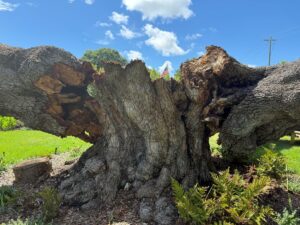
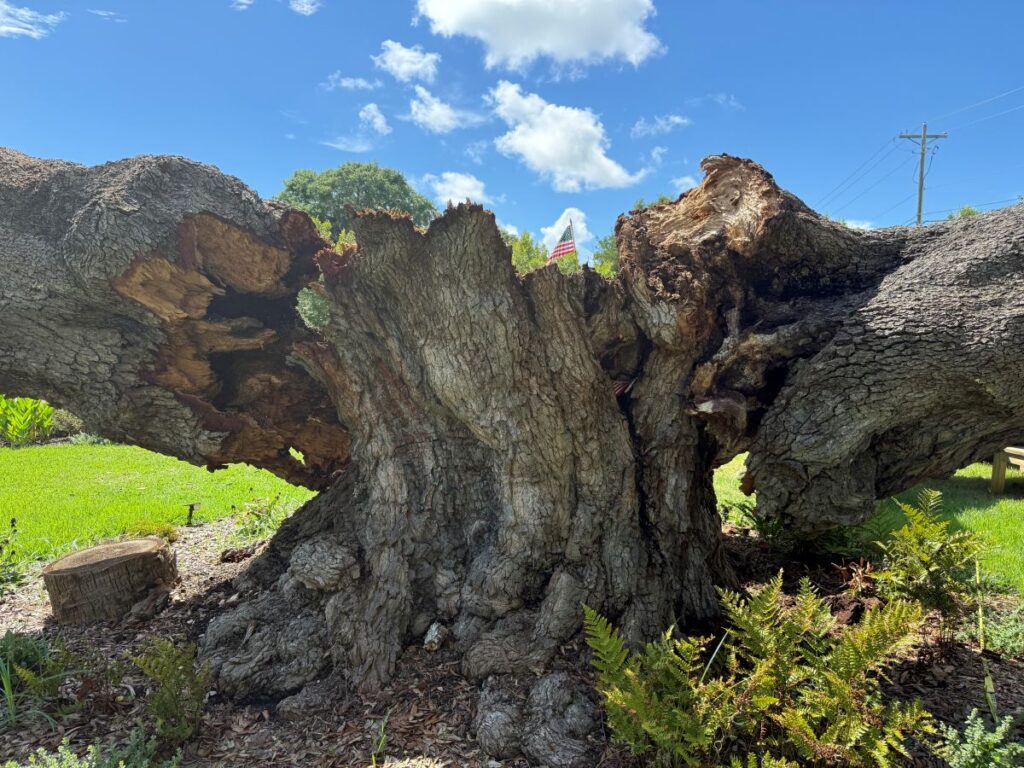
Now, Beaufort’s Witness Tree has fallen.
The remaining portion of the centuries-old tree came down overnight Sunday, Aug. 30 into Aug. 31, just weeks after a large section of the live oak split and fell.
Until then, there had been hope that what remained could be saved.
Ginger Olszewski, who had been serving as interim executive director of the Pat Conroy Literary Center, said an arborist had evaluated the remaining portion of the tree and believed it could survive with pruning and additional work.
“We were planning to keep it, to have the work done and to keep it, but Mother Nature had other plans,” Olszewski said.
The rest of the tree apparently fell sometime during the night.
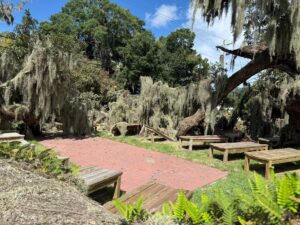
What happens next isn’t yet clear, but Olszewski said the literary center wants the site to remain a place for the community.
“We would love to keep the park,” she said. “It’s really early in the conversation. So there are lots of ideas, but we haven’t really landed on a permanent decision on what we’re going to do that we all agree upon.”
Whatever ultimately replaces the tree, Olszewski said the center hopes to preserve the purpose of the park.
“We would like to keep it in some way and make it useful and still remain a place where people can come and relax and sit, even though the tree will be gone,” she said.
A tree that witnessed history
The loss is about more than an old live oak.
The tree earned its “Witness Tree” name because it was already standing during the Civil War and can be seen in an 1864 photograph of Black Union soldiers assembled on a parade ground in Beaufort.
The photograph shows members of the 29th Connecticut Colored Infantry, an all-Black Union regiment that spent about four months stationed in Beaufort during the spring and summer of 1864.
According to the National Park Service, the regiment camped near what is now Beaufort Elementary School and was photographed in formation on the downtown parade ground near Bladen and King streets.
The image has become one of the best-known Civil War photographs documenting Black military service.
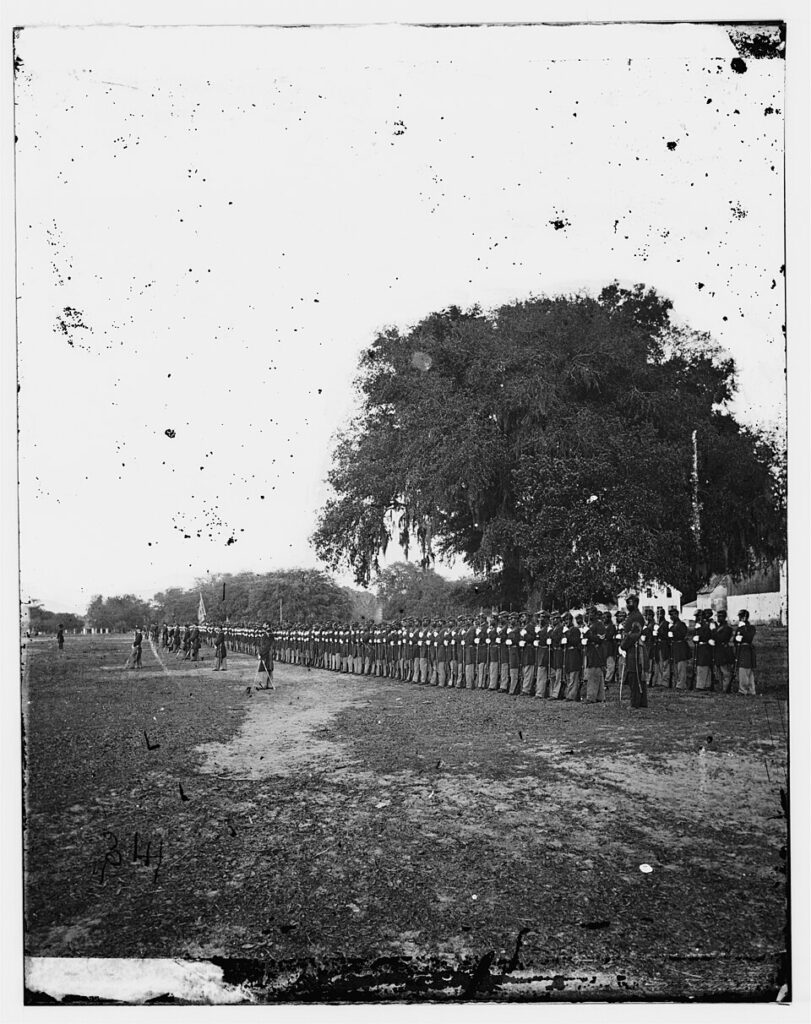
The live oak visible alongside those soldiers remained standing more than 160 years later.
The Pat Conroy Literary Center has said the historical significance of the tree came to its attention after the Beaufort Historical Society shared the 1864 photograph showing the tree. That discovery eventually helped inspire the creation of Witness Tree Park.
The 29th Connecticut Colored Infantry was organized in early 1864 as one of the Union Army’s Black regiments. After arriving in Beaufort that spring, the soldiers remained until August before being sent north to join fighting in Virginia.
The tree itself has been estimated to be around 300 years old, meaning it was already well established when the soldiers gathered beneath and around it in 1864.
More recently, the small park surrounding it has served as a place for literary and historical programming, as well as a place for people to sit beneath the tree that connected modern Beaufort with a photograph taken during an important time in the city and the nation’s history.
What happens to the tree now?
The property itself belongs to Beaufort County.
Hannah Nichols with Beaufort County said the county has an agreement with the Pat Conroy Literary Center for maintenance of the park and tree, and questions about what happens next are being directed to the center.
The arrangement dates to 2023, when Beaufort County Council approved a lease allowing the literary center to use a portion of county-owned property at 1511 North Street as a public park.
Under the agreement, the literary center is responsible for maintaining the park, including mowing, landscaping, grounds and planting care. The agreement specifically includes trees among the landscaping the center is responsible for maintaining.
Nichols said she believed one possibility being discussed was a fundraiser featuring artwork made from fallen limbs of the Witness Tree, although those plans have not been finalized.
For Robert L. Gwaltney, the literary center’s new executive director, dealing with the loss of one of the center’s most recognizable landmarks became an unexpected part of his first day on the job.
Gwaltney arrived at the center Aug. 31, a day before his official Sept. 1 start date, and found himself talking with county representatives and others about the tree.
“It’s a really old tree, and it has seen much, and it has served the community well,” Gwaltney said.
While the loss is disappointing, Gwaltney said it also presents an opportunity to find another way to preserve what the tree represented.
“Where there are challenges, there are opportunities,” he said. “We have to be able to continue to honor the history of Beaufort and the history of that tree.”
Delayna Earley, who joined The Island News in 2022, formerly worked as a photojournalist for The Island Packet/The Beaufort Gazette, as well as newspapers in Indiana and Virginia. She can be reached at delayna.theislandnews@gmail.com.