
Developers renew bit to remove 502 acres from the Cultural Protection Overlay
By Delayna Earley and Mike McCombs
The Island News
The owners of Pine Island are once again asking Beaufort County to remove the approximately 502-acre property from the Cultural Protection Overlay, reopening a years-long fight over the zoning protections that prohibit golf courses, resorts and gated communities on St. Helena Island.
Pine Island Property Holdings LLC filed the zoning map amendment application Sept. 2 seeking to remove the Cultural Protection Overlay, or CPO, from approximately 502 acres while retaining the property’s underlying T2 Rural zoning. Attorney Kevin Dukes is listed as the applicant on behalf of the property owner.
The application lists the reason for the request as “to preserve the Rural character of the Property,” arguing that the T2 Rural zoning designation is consistent with the county’s Comprehensive Plan and its future land use designation of the property as rural.
The filing marks the latest chapter in a dispute over Pine Island that has stretched from county meeting rooms to state and federal courts since 2022.
“This marks the fifth year of this soap opera,” Robert New, who has been involved in community opposition to the proposed development for several years, told The Island News.
New believes the timing of the latest application is significant, pointing to changes coming to Beaufort County Council following the November election.
“They know their only hope is to get this through the [County] Council before the end of the year when the new council members take office,” New said.
The four-page application does not propose a specific development. Instead, the property owners argue that removing the CPO while retaining T2 Rural zoning would maintain the rural character of St. Helena Island and would not adversely affect surrounding properties. The application states that the requested amendment “authorizes no development” and that any future development would be reviewed separately.
In a written response to The Island News, Elvio Tropeano, who represents the Pine Island property, emphasized that the application includes no proposed use, site plan, subdivision, dwelling unit count or development agreement. Tropeano said the county’s Comprehensive Plan designates the property’s future land use as Rural and that T2 Rural is the zoning district paired with that designation.
Tropeano said the application, if approved, would not authorize construction.
“If it is approved, the property is zoned Rural. Nothing is approved to be built,” Tropeano wrote. He said the current zoning already permits residential development and that the outcome of the zoning application would not change that.
The distinction is important because the property’s underlying T2 Rural zoning already allows residential development at a density of one dwelling unit per 3 acres. The Cultural Protection Overlay sits on top of that zoning and restricts certain uses, including golf courses, resorts and gated communities.
Tropeano emphasized that distinction in his written response to The Island News, saying the application does not create new residential development rights.
“I am developing the property. Not hypothetically, and not someday,” Tropeano wrote. “The current zoning permits residential development. The outcome of this application does not change that reality; anything to the contrary is simply not true.”
Residential development on the property has already moved forward under the existing zoning. In January, Beaufort County approved a proposal for 20 single-family residential units on a 64-acre portion of Pine Island. County records show the proposal was reviewed as a 20-lot single-family residential development under the existing zoning.
The property owners also previously pursued a larger residential plan for 144 homes based on the T2 Rural density of one home per 3 acres. That proposal encountered development-code and archaeological concerns, and no further action was pursued on the 144-home plan, according to the South Carolina Environmental Law Project.
The current application is therefore narrower than the development proposals that have dominated the Pine Island dispute in recent years. It does not seek approval for a specific residential development or golf course. Instead, it seeks to remove the CPO while leaving the underlying T2 Rural zoning in place.
The latest application comes almost exactly a year after more than 500 people attended a 7½-hour County Council meeting and public hearing in September 2025, when council members voted 10-1 to deny a proposed development agreement for a gated golf resort on Pine Island.
It is also the third time the developers have tried to have the Pine Island property removed from the CPO. The Beaufort County Planning Commission unanimously recommended denial of a rezoning request involving the property in 2023 before County Council rejected it 8-2. The Planning Commission again unanimously recommended denial of a rezoning request in 2025.
The developers cannot legally file another development agreement application until after Sept. 23, one year after the previous development agreement was denied. It is not yet known whether they intend to submit a new development agreement once they are eligible to do so.
The CPO was established in 1999 to protect St. Helena Island’s rural character and Gullah/Geechee cultural heritage. Among its restrictions are prohibitions against golf courses, gated communities and resorts on the island.
New said the fight against the proposed Pine Island development has involved far more than any one person, pointing to years of involvement from residents and organizations including Penn Center, the Coastal Conservation League, the Gullah/Geechee Sea Island Coalition and SCELP.
“I’m not the only one. A lot of people have put their hearts and souls into this,” New said. “There are problems on St. Helena. We know this. Things aren’t perfect. But what [Beaufort County Administrator Eric] Greenway was doing was a terrible, terrible injustice.”
Eric Greenway was Beaufort County administrator during the early stages of the Pine Island controversy. County records show Greenway was involved in the county’s handling of the CPO and Pine Island zoning process. In January 2023, the Planning Commission considered proposed changes to the CPO that Greenway said were prompted by legal concerns. The commission ultimately rejected the proposed text amendments after extensive public opposition.
Greenway also corresponded directly with Pine Island GC LLC in November 2022 regarding the company’s zoning map amendment application, writing that the county’s pending CPO text amendment would cause action on the Pine Island application to be deferred.
Greenway was placed on paid leave in July 2023 and County Council later voted unanimously in September 2023 to uphold his termination with cause. County Council cited procurement and personnel violations in its decision.
The renewed zoning effort comes as litigation over Pine Island and the CPO continues.
Developers have filed three lawsuits related to the property and the overlay since 2023. The state court challenge was voluntarily dismissed in December 2025, while a federal case filed in 2023 was dismissed as moot in February 2026. A request for reconsideration was denied in March, and the developers appealed the dismissal to the Fourth Circuit Court of Appeals.
In April, the developers filed a separate federal lawsuit directly challenging the CPO as unconstitutional and alleging that its protections for St. Helena’s rural character and Gullah/Geechee cultural heritage amount to racial discrimination. The developers are seeking damages and asking the court to end enforcement of the CPO. That case was stayed in June pending the outcome of the Fourth Circuit appeal.
The litigation was discussed behind closed doors during Beaufort County Council’s Sept. 14 caucus meeting.
Council’s agenda listed “Pine Island Property Holdings, LLC and Pine Island GC, LLC v. Beaufort County” among the matters scheduled for executive session for legal advice related to pending litigation or other matters covered by attorney-client privilege.
Council took no public action related to Pine Island after returning to open session. The only action coming out of that executive session involved a proposed settlement in an unrelated condemnation case involving Nova Industrial Properties LLC.
But Pine Island and the CPO were also part of the conversation outside of executive session.
Public interest in the issue was also apparent Monday night, when the Beaufort County Council chambers were filled for the Sept. 14 meeting.
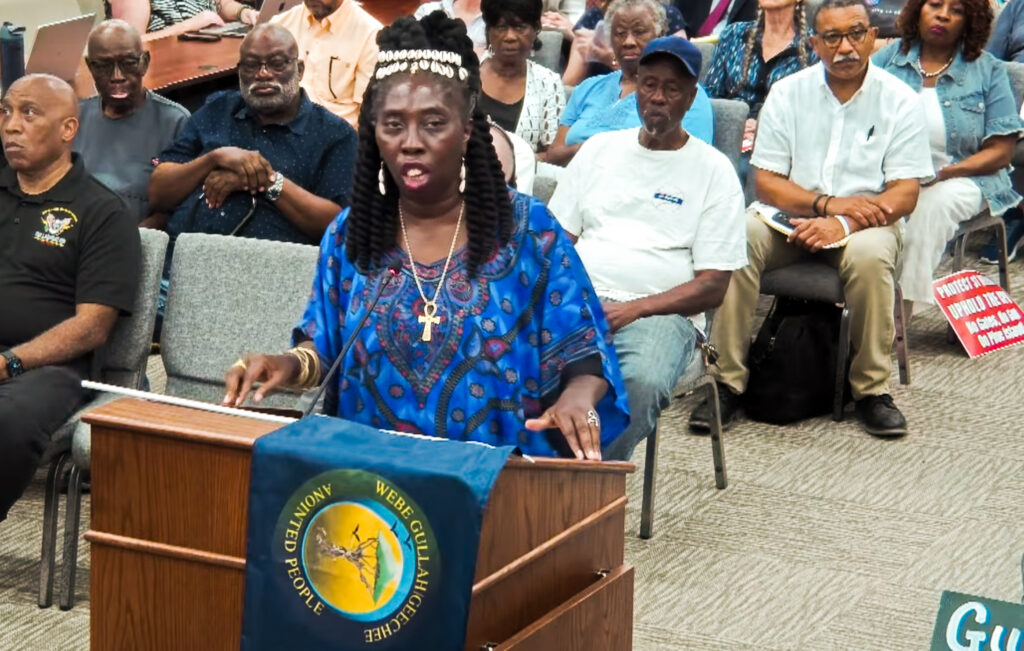
During public comment at the Sept. 14 meeting, Queen Quet urged council members to continue protecting the CPO, tying the issue to St. Helena Island’s Gullah/Geechee history and the generations buried on the island.
Queen Quet spoke about burial areas on St. Helena and the graves of U.S. Colored Troops and Spanish-American War soldiers, some of whom she said were her ancestors.
“It’s important that we uphold our comprehensive plan and our Cultural Protection Overlay District,” Queen Quet told council members.
Another resident followed with a similar request, asking council members to “continue to uphold the CPO” and not carve anything out of it for a particular property.
Tropeano declined to comment specifically on the CPO, saying it is the subject of pending litigation. He instead said the discussion surrounding Pine Island should be broadened to include the future of St. Helena Island as a whole.
Tropeano said he has spent the past five years meeting with residents, families, business owners, children, teens, elders and veterans and hearing concerns about schools, roads, drainage, public safety, employment, business and community and recreation facilities.
“These conversations are real, these concerns are real, and they are not being solved by a fight over one parcel,” Tropeano wrote. He encouraged residents concerned about Pine Island to also focus on what he described as longstanding issues affecting the broader St. Helena community.
The new zoning application will now move through Beaufort County’s review process.
SCELP has said the application is expected to go before the Beaufort County Planning Commission at its Oct. 5 meeting, although the organization noted that the agenda had not yet been posted to confirm that date. The Planning Commission would make a recommendation before the request could move to County Council.
If the zoning change reaches County Council, it would require three readings and a public hearing before it could receive final approval.
For New, who said he became involved in the Pine Island issue in early 2023 after being encouraged to attend a Planning Commission hearing, the latest filing is another round in a fight that he and other opponents have no intention of abandoning.
He credits County Council with standing by the CPO despite the repeated development proposals and legal challenges.
“They haven’t won a single thing [in court],” New said. “What they’re doing is engaging in warfare. What they’re doing is continuing [the lawsuits], assuming the Council will eventually cave.”
Editor’s note: The online version of this story has been updated to include written comments from Elvio Tropeano, who represents the Pine Island property. His response was received after the print edition deadline.
Delayna Earley, who joined The Island News in 2022, formerly worked as a photojournalist for The Island Packet/The Beaufort Gazette, as well as newspapers in Indiana and Virginia. She can be reached at delayna.theislandnews@gmail.com.