By Luke Frazier
The Island News
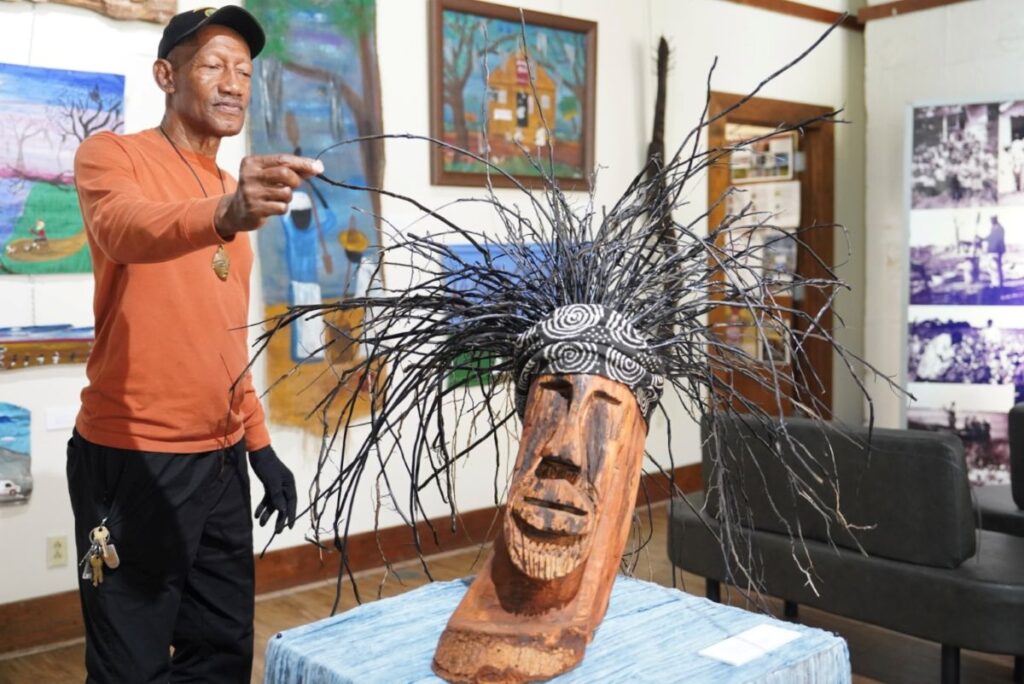
Visiting the current exhibition of work by South Carolina folk artist Bruce Ingram at the Penn Center’s York W. Bailey Museum is like watching a wonderful short story collection unfold while listening to a playlist of exquisitely reflective songs.
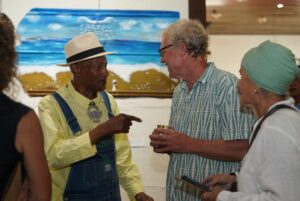
The show is called Manifesting the Spirit: The Visionary Art of Bruce Ingram and is on exhibit through Monday, Nov. 30. Ingram is okay with the title’s pinch of art-speak terminology.
“To me, visionary represents the vision that the Lord brings to me,” Ingram said, before relating how as a young boy walking along, he would see a piece of wood or stone that, “Told me to pick it up and take it home because it wants to be something.”
Ingram’s art is realized across a variety of forms. There are stories about growing up on a Horry County farm and encountering the Lord. Paintings about wondering and wandering and marveling. Sculptures about seeking to understand the ways of the world in the rural south in the distant past and into the future.
Ingram also says he was intrigued by nature itself.
“Coming up on our tobacco farm as a child, I used to love going into the middle of a field and lay on my back and watch the clouds,” Ingram said, and remembers seeing a rainbow and thinking, “How fascinating it is that the Lord would allow such beautiful colors to be in the sky like that.”
The 66-year-old Ingram couldn’t recall a time when he wasn’t making art of some kind and now puts the number of his finished pieces at around five hundred. He paints on various kinds of surfaces, including tin (first as an experiment when he couldn’t afford canvases) to reclaimed wood, canvas, and fabric. His sculptures incorporate various metals, fabrics and wood. In this show there are more than sixty works of art.
“It’s in my blood, my DNA,” Ingram says about his art, “[It’s] a family trait, my kids are artists too.”
Much of his work ties back to family lineage, personal and historical. He was raised mostly by his uncle and had a great grandfather who lived to be one hundred fourteen years old. Ingram was provided a rich stew of stories by these men and other family members and considers it important that these narratives survive. Ingram credits his daughter Ivy for doing this by helping him write and publish a book called Wisdom Stories.
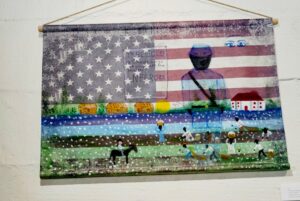
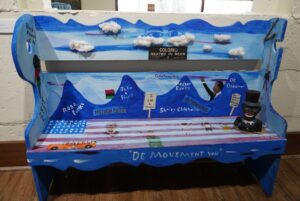
But the reality of history also includes stories of slavery, racism, and oppression, and Ingram’s art doesn’t avoid tackling those stories as well. Among the bright folk art scenes of fishing holes, birds in flight, and church suppers are works that put the horrors of slavery and lynching front and center. One of these is the painting “Freedom Fighter’s Spirit.”
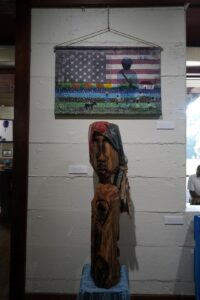
This painting presents a washed out American flag across the top half of its banner-like canvas. A silhouette of a black Union soldier stands among the red and white stripes on the right hand side. The bottom half shows black field workers in a snowstorm of cotton being watched by a white man on horseback. Straddling the intersection of the flag’s stars and stripes is a faded and barely readable handbill announcing, “TO BE SOLD / a Choice Cargo of about 250 Fine Healthy NEGROES.” But Ingram reminds us that slaveholders aren’t the only ones watching. He inserts a pair of “almighty eyes” looking on from the top right corner, a motif he repeats in other works. Ingram says the moral of this work is simple, “Freedom isn’t free.”
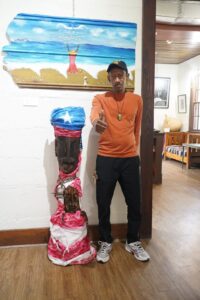
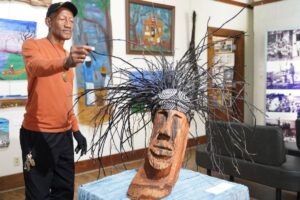
Another work, the sculpture titled “My Country ‘Tis of Thee,” is less specific than “Freedom Fighter’s Spirit.” It has no text but in its indication of family bondage it is perhaps even more powerful.
There are two faces carved in a single piece of dark wood in a way that suggests a mother carrying a child. Wrapped around the top figure’s head is a red, white, and blue fabric cap with the white part in the shape of a star. Beneath this face and crowding down onto the smaller figure is more red and white draped fabric, which then continues to the bottom below the face. The kick in the teeth is the wrapped chains and manacles around the middle and down the side, creating a notion of captivity and domination.
With the tune “America” playing in your head after reading the title (which is, of course, the first line of the song) you soon arrive at the second line, “Sweet land of liberty …” and realize how far short we fell as a country for so long. Putting figures in chains as a political statement has rarely been done with such eloquence.
In a unique way music is brought into the show full force with a series of work focusing on Blues music. Ingram points out that he was raised about two miles from a “juke joint” and as a child he felt like he couldn’t wait to be a part of that dancing and captivating musical rhythms. Today he often works on his art while listening to music by Howling Wolf, Louis Armstrong, and Muddy Waters.
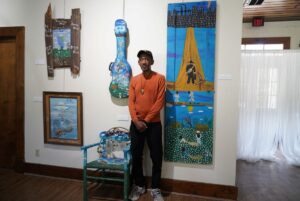
The series includes a strikingly complex collage of a guitar case of blues references, names and imagery (“Born in America — The Blues”); a pleasantly shimmery and ethereal painting of a guitar player (“Spirit of the Bluesman”); a large vertical painting that includes a crossroads, ball & chained convicts, and cotton field workers underneath a bluesman heading into the city (Crossroad Blues); and a painting of a spirit rising over a cotton field framed in rough wood on which are painted the names of iconic blues songs (“Blues Spirit”).
The entire series is stellar, vibrant and evocative of the rich cultural history of this most American of music genres. It seems to be tied back to both the positive experiences Ingram had as a child that are evident in the more pastoral folk art scenes and the recognition of the rough edges of life in the never ending nightmare of racist legacy.
I’m not a blues scholar, but I know a good tune when I hear it. Ingram’s blues series is fine work, playing like a guitar solo that transports you to a land of the sweet bye and bye.
Overall the show is worthy of not only visiting but repeat visits. If you feel the need to leave on a positive note, make the painting of an elder looking at a TV with President Obama appearing on the screen (“Never Thought I’d See the Day”) your last stop.
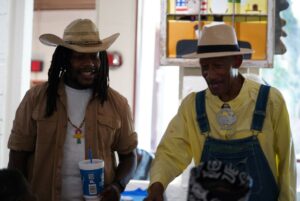
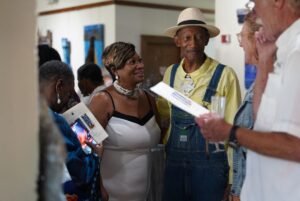
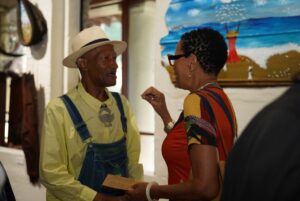
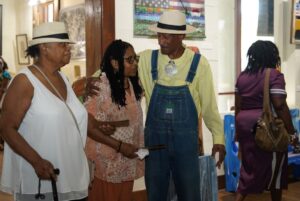
And you can also take solace in the exhortation of Bruce Ingram himself on the night of the opening reception. He repeated to the crowd, “Find your art, find your art …”
When asked about this message later Ingram said, “I feel everyone is born with a gift, a creative gift. Whatever you have a passion for, ask the Lord to reveal the gift he has for you.”
It’s no mystery what the Lord has revealed about Ingram. He is an artist of vision, depth, and intuitive power who harkens the past for us to appreciate, even as we might weep under its weight.
Luke Frazier is a writer and award winning media producer who moved to the Lowcountry in 2024. He runs NOW Communications and can be reached at nowandfuturecomms@gmail.com.