
Candidates weigh in on crime, growth, transparency ahead of June 9 primary election
By Delayna Earley
The Island News
Ahead of the June 9 primary election, The Island News sent detailed candidate questionnaires to those running in several contested local and state races impacting Beaufort County voters.
Questionnaires were sent to candidates in the Beaufort County Sheriff Republican primary, Beaufort County Council District 4 and District 5 Republican primaries, and the South Carolina House District 121 Democratic primary. Each questionnaire included a general candidate information section, along with 10 issue-focused questions tailored specifically to the office being sought.
Questions focused on topics currently impacting Beaufort County and the Lowcountry, including public safety, gang activity, growth and infrastructure, affordable housing, transparency in government, Pine Island and the Cultural Protection Overlay, property insurance costs, education, environmental concerns and the relationship between local and state government.
Candidates were also invited to submit guest opinion columns as part of the publication’s election coverage.
All candidates contacted by The Island News participated in the questionnaire process and submitted responses.
Due to print space limitations, only portions of candidate responses appeared in print. Each candidate’s questionnaire responses appear in their entirety at the end of this story.
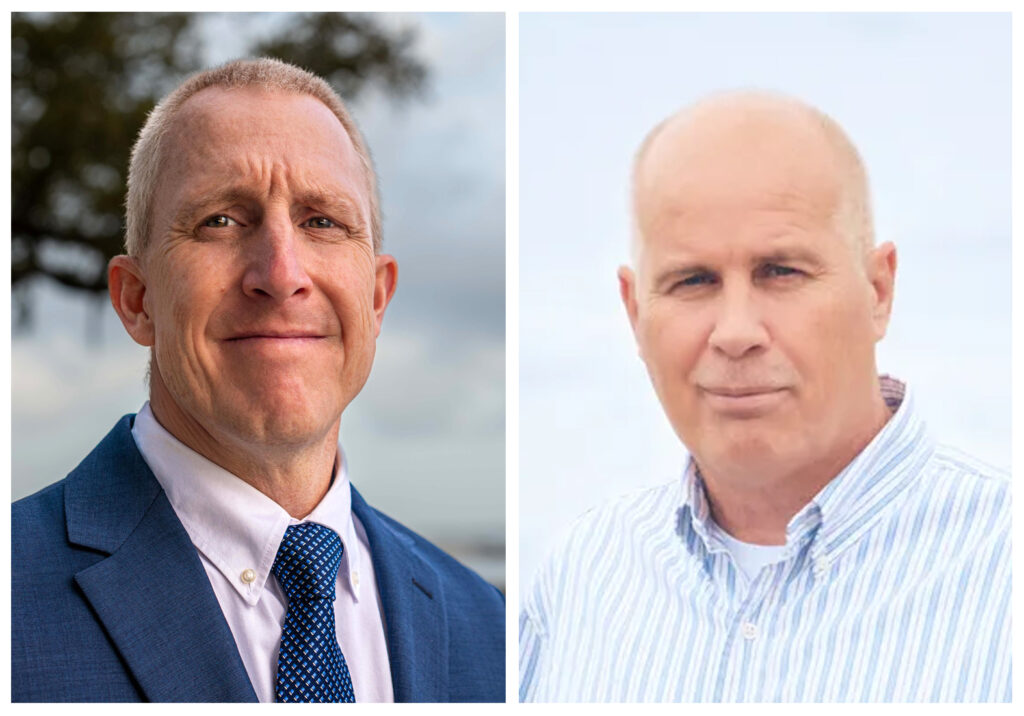
Beaufort County Sheriff
Doug Seifert and Joey “JoJo” Woodward Jr. offered sharply different views on the current direction of the Beaufort County Sheriff’s Office, with both candidates emphasizing public safety, transparency and support for deputies while differing on priorities, leadership style and the agency’s current performance.
Seifert is originally from Cincinnati, Ohio, and has lived in Beaufort County for 20 years. A former Beaufort County Sheriff’s Office lieutenant, Seifert said he is running to continue moving the agency forward while supporting deputies and strengthening public trust. He lives on Hilton Head Island with his wife, Shelly, and their family.
Woodward, a Bluffton native, has lived in Beaufort County for nearly 40 years. He previously served 26 years with the Beaufort County Sheriff’s Office before later working with the 14th Circuit Solicitor’s Office and Jasper County Sheriff’s Office. Woodward said he is running to improve accountability, transparency and crime-solving efforts within the agency. He and his wife, Tracy, have four children and 10 grandchildren.
When asked what they believe is Beaufort County’s biggest public safety issue, the two candidates pointed to very different concerns.
Seifert identified infrastructure and traffic congestion as the county’s top public safety challenge, arguing that rapid growth has strained emergency response and roadway safety throughout Beaufort County.
“The lack of infrastructure is creating the biggest public safety issue in Beaufort County,” Seifert wrote, pointing to traffic accidents, aggressive driving and increasing call volume for deputies. He said he would dedicate additional road deputies specifically to traffic enforcement and roadway incidents while continuing to advocate for slowing growth until infrastructure improves.
Woodward instead focused on crime clearance rates, arguing too many crimes in Beaufort County go unsolved.
“The collapse of our crime clearance rate” is the county’s biggest issue, Woodward wrote, stating that “7 out of 10 crimes in this county go unsolved.”
Both candidates agreed with Sheriff P.J. Tanner’s assessment that gang activity and illegally modified firearms are growing concerns in Beaufort County, particularly following the 2025 St. Helena Island mass shooting.
Seifert emphasized expanding youth outreach and prevention programs alongside stronger enforcement and partnerships with prosecutors and federal agencies. He advocated for additional recreational programs, mentorship opportunities and greater community engagement from deputies.
Woodward focused more heavily on enforcement and federal coordination, pledging to strengthen relationships with agencies including the DEA, ATF, U.S. Marshals Service and ICE.
“I know how to use them,” Woodward wrote regarding his federal law enforcement relationships.
When asked about lessons learned following the St. Helena mass shooting investigation, Seifert said county government, residents and law enforcement all share responsibility in addressing crime and nuisance locations, while emphasizing the importance of anonymous tip reporting and coordination between prosecutors and law enforcement.
Woodward declined to second-guess investigators in an active case but said major incidents should always be followed by honest “after-action reviews” examining what worked, what failed and what improvements are needed moving forward.
The candidates also addressed public trust and transparency during major investigations and controversial incidents involving law enforcement.
Seifert repeatedly stressed the importance of balancing transparency with protecting active investigations, saying the sheriff’s office must communicate with the public while ensuring cases are not jeopardized.
“The reality is that not all information regarding an active investigation or pending criminal matter can immediately be shared with the public,” Seifert wrote.
Woodward similarly argued for transparency, but said law enforcement agencies should avoid using ongoing investigations as an excuse to avoid accountability.
“Silence is not strategy — it destroys trust,” Woodward wrote.
Both candidates also addressed standards for deputies while off duty following several recent high-profile incidents involving law enforcement personnel in the Lowcountry.
Seifert emphasized that deputies remain subject to departmental policies and internal investigations both on and off duty, while also noting that incidents involving potential criminal conduct should continue to be independently investigated by SLED.
Woodward similarly argued that “a badge does not clock out,” writing that deputies should be held to professional standards at all times and that use-of-force decisions while off duty must be grounded in judgment and restraint.
On deputy recruitment and retention, both candidates acknowledged ongoing staffing and morale issues facing law enforcement agencies statewide.
Seifert emphasized continued investment in competitive pay, technology, training and equipment, saying deputies need to feel valued and supported by leadership.
Woodward proposed increasing starting deputy pay to $64,000 and giving all sheriff’s office employees a $3,000 raise. He also argued deputies need a clearer path for advancement within the agency.
Both candidates voiced support for Beaufort County’s participation in ICE’s 287(g) program, which allows specially trained deputies to assist with certain federal immigration enforcement efforts.
Seifert described the program as an important partnership while emphasizing that all agreements involving the sheriff’s office should continue to be reviewed to ensure they serve Beaufort County appropriately.
Woodward took a more aggressive stance, saying he would expand and strengthen the program as part of broader cooperation with federal law enforcement agencies.
“287(g) closes those gaps,” Woodward wrote regarding criminal networks operating across jurisdictions.
When asked what distinguishes them from their opponent, Seifert emphasized his 20 years working within the Beaufort County Sheriff’s Office and argued his continued involvement with the agency gives him firsthand knowledge of its current operations and needs.
Woodward highlighted his nearly 40 years in law enforcement, federal partnerships and leadership experience, while also criticizing what he described as declining crime-solving performance within the current administration.
Whoever wins the Republican primary will advance to face Democrat Alphonso Small Jr. in the November general election.
1. What do you believe is the single biggest public safety issue currently facing Beaufort County?
Seifert: The lack of infrastructure is creating the biggest public safety issue in Beaufort County. This issue results in significant traffic congestion, leading to more traffic accidents, traffic fatalities and aggressive driving behavior.
In 2025 alone, the Beaufort County Sheriff’s Office wrote more than 8,000 warning tickets, 6,500 citations and investigated more than 1,100 traffic accidents while responding to 140,000 calls for service.
If elected sheriff, I plan to dedicate road deputies solely to enforcing traffic laws and responding to roadway incidents. By creating a stronger traffic enforcement division, we can more efficiently handle congestion and minor accidents while allowing other deputies to remain focused on proactive law enforcement, crime prevention and rapid response to serious incidents throughout Beaufort County.
Additionally, I will continue encouraging municipal, county and state leaders to temporarily slow growth and allow us to build the infrastructure needed to support our current and growing population.
Woodward: The collapse of our crime clearance rate. In 2024, BCSO solved just over 30% of crimes, meaning seven out of 10 crimes in this county go unsolved. Criminals have noticed. Victims and their families are not getting justice.
That is the foundational failure everything else flows from. Until we fix clearance rates, every other public safety effort is undermined.
2. Following the St. Helena Island mass shooting, Sheriff P.J. Tanner warned about increasing gang activity and illegally modified firearms in Beaufort County. Do you agree with his assessment, and what specific strategies would you implement to address violent crime and gang activity?
Seifert: Yes, I agree with Sheriff Tanner that our county is dealing with increased gang activity and increased use of illegally modified firearms. These issues require a multifaceted approach from the Beaufort County Sheriff’s Office.
First, the Beaufort County Sheriff’s Office must continue partnering with local, state and federal agencies to ensure all available resources are being used appropriately. I also plan to support local leaders like Solicitor Duffie Stone, who has consistently advocated for a RICO law that would enhance law enforcement’s ability to investigate and charge gangs while giving South Carolina prosecutors the ability to effectively prosecute gangs and keep criminals off the street.
Second, we must provide alternative means of engagement for our youth to combat the attraction of gang activity and illegally modified firearms. If elected, I would work with County Council to continue investing in parks, athletic facilities, community centers, after-school programs, mentorship opportunities and safe recreational spaces for teenagers and young adults throughout Beaufort County.
Third, my community engagement team, made up of department personnel, will ensure the Beaufort County Sheriff’s Office is consistently involved in community events and outreach.
Fourth, good old-fashioned hard work and boots on the ground. I plan to work with County Council to increase salaries that would attract and retain exceptional men and women to the Beaufort County Sheriff’s Office.
Finally, when someone is arrested and charged, we need swift and robust prosecution. I plan to work with the Solicitor’s Office and our federal partners within the Department of Justice to identify individuals who can be fully prosecuted on either the state or federal level.
Woodward: Yes, I agree. Gang activity and illegally modified auto-switches are a real and growing threat in this county. I have seen this firsthand through my work on the Lowcountry Human Trafficking Task Force and my federal law enforcement partnerships.
My approach: put more boots on the ground in enforcement, immediately strengthen every federal partnership we have — DEA, ATF, U.S. Marshals and ICE — and make clear to every gang network operating here that Beaufort County is closed for business.
I have spent nearly 40 years building exactly the relationships that make that promise real. I know how to use them.
3. Looking back at the St. Helena Island mass shooting investigation, is there anything you believe law enforcement or county leadership could have handled differently — either before or after the shooting occurred?
Seifert: I believe we must all share the responsibility. The County of Beaufort could be more responsive in the enforcement of county ordinances in potential nuisance locations.
All citizens have the responsibility to report concerns or grievances to law enforcement and local leaders. The use of the Beaufort County Sheriff’s Office Crime Stoppers tip line is critical for individuals who want to report information anonymously.
The Beaufort County Sheriff’s Office must work in concert with prosecutors at the Solicitor’s Office and the federal government to identify bad actors, and we must ensure those individuals receive robust and timely prosecution.
Woodward: I will not second-guess active investigators or pending cases from the outside.
What I will say is this: any time a community experiences a tragedy of that magnitude, every agency involved owes it to the victims and the public to conduct a full after-action review — what worked, what did not and what needs to change.
That is not criticism. It is professional accountability. As sheriff, I will build a culture where that kind of honest review is standard practice, not the exception.
4. In the aftermath of the St. Helena shooting, some residents questioned communication with the public and the pace of arrests. How would you approach public transparency during a major investigation while still protecting the integrity of the case?
Seifert: The reality is that not all information regarding an active investigation or pending criminal matter can immediately be shared with the public, as prematurely releasing certain details can jeopardize investigations, impact victims and witnesses and ultimately affect the successful prosecution of offenders.
However, I plan to continue the use of Nixle, which allows for a text-based notification either countywide or targeted to a particular geographical area, to immediately inform the public of any ongoing or imminent danger to the community.
Following the release of that notification, I would plan to hold press conferences to keep the public informed of the ongoing actions of the Beaufort County Sheriff’s Office.
Though information may at times be limited, I believe it is extremely important to reassure the public that the Beaufort County Sheriff’s Office is working diligently, professionally and compassionately to resolve whatever situation has occurred.
Woodward: You can be transparent without being reckless. The public deserves to know that law enforcement is working, that cases are being pursued, that resources are being deployed and that no one is being forgotten.
What cannot be disclosed is information that would compromise an arrest, jeopardize a prosecution or tip off a suspect.
I would establish a clear communications protocol from Day One: regular public updates on what can be said, honest acknowledgment of what cannot and a direct point of contact for families of victims.
Silence is not strategy. It destroys trust. Transparency within legal bounds is both the right thing and the smart thing.
5. Deputy recruitment and retention continues to be a challenge statewide. What specific steps would you take to improve staffing, morale and retention within the Beaufort County Sheriff’s Office?
Seifert: Deputy recruitment and retention begin with making sure our personnel feel valued, supported and properly equipped to do their jobs safely and effectively.
To improve recruitment and retention, we must continue working with County Council to provide competitive wages that allow us to attract and keep high-quality deputies here in Beaufort County.
We must also couple competitive pay with continued advancements in technology, training and equipment so our deputies can work smarter, safer and more efficiently.
After more than two decades in law enforcement, I understand morale is not built by words alone. It is built by leadership that listens, provides support and gives deputies the resources they need to succeed both professionally and personally.
Woodward: Day One: Starting deputy salary goes to $64,000. Every BCSO employee receives a $3,000 raise.
But this is not just about money. Deputies are leaving because they feel trapped with no path forward. I will build a real merit-based promotion structure, one that rewards performance and gives every deputy a reason to build their career here.
I will address the culture problems directly. The good deputies who left Beaufort County for better opportunities elsewhere, I want them back. And the ones still here, I am fighting for them.
6. Recent high-profile incidents involving off-duty law enforcement personnel in the Lowcountry have generated public discussion regarding appropriate conduct, decision-making and use of force while off duty. What standards and expectations should apply to deputies when they are not actively on duty?
Seifert: The Beaufort County Sheriff’s Office is a policy-driven and nationally accredited law enforcement agency through the Commission on Accreditation for Law Enforcement Agencies, with oversight through the Office of Professional Responsibility.
Deputies are expected to uphold the law and conduct themselves professionally both on and off duty because the public’s trust in law enforcement does not end when a shift is over.
Any actions by a deputy sheriff, whether on duty or off duty, are subject to the policies and standards of the Sheriff’s Office, and all potential policy violations are thoroughly reviewed by the Office of Professional Responsibility.
If any matter rises to the level of potential criminal conduct, SLED is immediately requested to conduct an independent investigation to ensure transparency, accountability and public confidence in the process.
Woodward: A badge does not clock out. Deputies are representatives of BCSO and the public trust at all times.
Off-duty conduct must reflect the same standards of judgment, restraint and professionalism expected on duty. That includes use of force — the threshold for off-duty intervention must be grounded in law and sound judgment, not ego or impulse.
As sheriff, I will establish clear, written off-duty conduct expectations and ensure every deputy knows them. Accountability applies around the clock.
7. Public trust can be challenged when incidents involving law enforcement become highly publicized before criminal cases are resolved in court. How would your administration balance transparency and accountability with protecting the integrity of ongoing investigations and pending court proceedings?
Seifert: I understand that when a serious incident becomes public, people want answers immediately, and it can be frustrating when all of the details cannot yet be released.
However, the Beaufort County Sheriff’s Office is legally and ethically required to protect the integrity of any criminal investigation and future court proceeding.
With that being said, I believe timely communication through Nixle notifications, press conferences and social media is critical to maintaining public trust.
Even when all details cannot yet be shared, the Beaufort County Sheriff’s Office should acknowledge when an incident has occurred, communicate what can responsibly be released and reassure the public the matter is being handled professionally, thoroughly and transparently.
Woodward: The same principle applies here as in Question 4: transparency within legal and ethical limits, every time.
My administration will not hide behind investigations as an excuse for silence. Where information can be shared, it will be. Where it cannot, because it would harm a prosecution or violate someone’s rights, I will say exactly that and explain why.
What I will never do is use “ongoing investigation” as a blanket shield for avoiding accountability.
The public has a right to know their Sheriff’s Office is doing its job, even when the details must remain confidential.
8. The Beaufort County Sheriff’s Office recently rejoined ICE’s 287(g) program, which allows specially trained deputies to assist with federal immigration enforcement. Do you support the program? Why or why not?
Seifert: I support the 287(g) program and believe partnerships between local, state and federal law enforcement can play an important role in keeping our community safe.
At the same time, I believe every agreement entered into by the Beaufort County Sheriff’s Office should be carefully reviewed to ensure it is serving the best interests of Beaufort County and being carried out appropriately, professionally and responsibly.
Programs such as 287(g) can provide valuable information-sharing opportunities and help law enforcement identify and apprehend undocumented individuals with serious criminal histories who pose a threat to public safety.
Woodward: Yes, I fully support it. Beaufort County’s existing 287(g) partnership with ICE is a law enforcement tool, and I will expand it, strengthen it and put real resources behind it.
I know from years of operational experience what happens when local and federal enforcement work together seamlessly — you take down networks, not just individuals.
Drug trafficking, human trafficking and violent crime are all connected to criminal networks that exploit gaps between jurisdictions. 287(g) closes those gaps.
As sheriff, I will use every lawful tool available to protect this community.
9. How would your administration approach transparency and accountability in incidents involving deputies that become highly publicized or controversial?
Seifert: I understand that when incidents involving law enforcement become highly publicized or controversial, the public wants answers quickly and expects transparency from their Sheriff’s Office.
At the same time, the Beaufort County Sheriff’s Office is legally and ethically required to protect the integrity of any criminal investigation and future court proceeding.
With that being said, I believe the immediate disclosure of information that can responsibly be shared through Nixle notifications, press conferences, social media and direct community engagement is critical to maintaining public trust.
Throughout this campaign, I have made myself available to the public because I believe leadership requires visibility, accessibility and honest communication, especially during difficult situations.
Woodward: With speed, consistency and honesty.
When an incident involving a deputy becomes public, the community deserves a prompt acknowledgment that it is being taken seriously — not silence, not spin.
Internal investigations will be conducted thoroughly and without interference. If discipline is warranted, it will happen. If an officer acted appropriately, I will say so clearly and explain why.
I will not throw deputies under the bus to manage public perception, and I will not protect misconduct to avoid controversy.
My standard is simple: What is true, and what does the evidence show? That is what the public will hear from me.
10. What distinguishes you from your opponent, and why are you the best candidate to lead the Beaufort County Sheriff’s Office?
Seifert: What distinguishes me is that I have spent the last 20 years actively serving the people of Beaufort County as a deputy sheriff, working in this community, raising my family here and building relationships at every level of law enforcement and public service.
Over the past eight years, while my opponent has been away from the day-to-day operations of this agency, the Beaufort County Sheriff’s Office has continued evolving through advancements in technology, training, science, accreditation and modern law enforcement practices.
I am not interested in tearing down this agency or the dedicated deputies who serve our community every day. I support them, I respect them and I want to provide them with the leadership, training, equipment and support they need to succeed.
My goal is to continue moving the Beaufort County Sheriff’s Office forward by strengthening public trust, supporting our deputies, building strong partnerships at the local, state and federal level and ensuring Beaufort County remains a safe place to live, work and raise a family.
Woodward: You cannot manufacture nearly 40 years of relationships, experience and community knowledge.
I have commanded 60 sworn officers. I have been deputized by the DEA and the United States Marshals Service. I have worked career criminal cases for the Solicitor’s Office. I am right now, while this campaign is happening, actively fighting human trafficking as co-chair of a five-county task force.
The record I am running against is clear: 30% of crimes solved, 14 murders in 2024 with eight still unsolved, drug clearance down seven straight years and a budget that grew 22% while results declined.
One candidate in this race is asking Beaufort County to continue that. I am asking this county to end it.
This is my home. My grandchildren are growing up here. I have spent nearly 40 years earning the right to lead BCSO, and I am ready on Day One.
Delayna Earley, who joined The Island News in 2022, formerly worked as a photojournalist for The Island Packet/The Beaufort Gazette, as well as newspapers in Indiana and Virginia. She can be reached at delayna.theislandnews@gmail.com.