
By Scott Graber
I am 80 years old and worry about my memory.
Sometimes — when I write about my past — I worry if my “facts” are accurate. In this regard some of my readers may recall a recent column about Hans Speidel.
Several months ago I wrote about a speech I believed I had heard at The Citadel in 1966. The speech was made by a Wehrmacht General, Hans Speidel, who had been Chief of Staff to Field Marshall Erwin Rommel, aka the “Desert Fox.” When I tried to verify this event — calling five The Citadel classmates — none remembered Speidel.

In an effort to verify this memory, I went to see Tessa Updike who serves as the Citadel’s Archivist and its Digital Librarian. Updike confirmed that Speidel came to The Citadel, twice, and did speak to the Corps.
While in Updike’s office I had the pleasure of seeing an inventory of everything that is archived in The Citadel’s Museum — General Mark Clark’s campaign papers; photographs of Clark at Panmunjom; medals and papers of graduates killed in Vietnam.
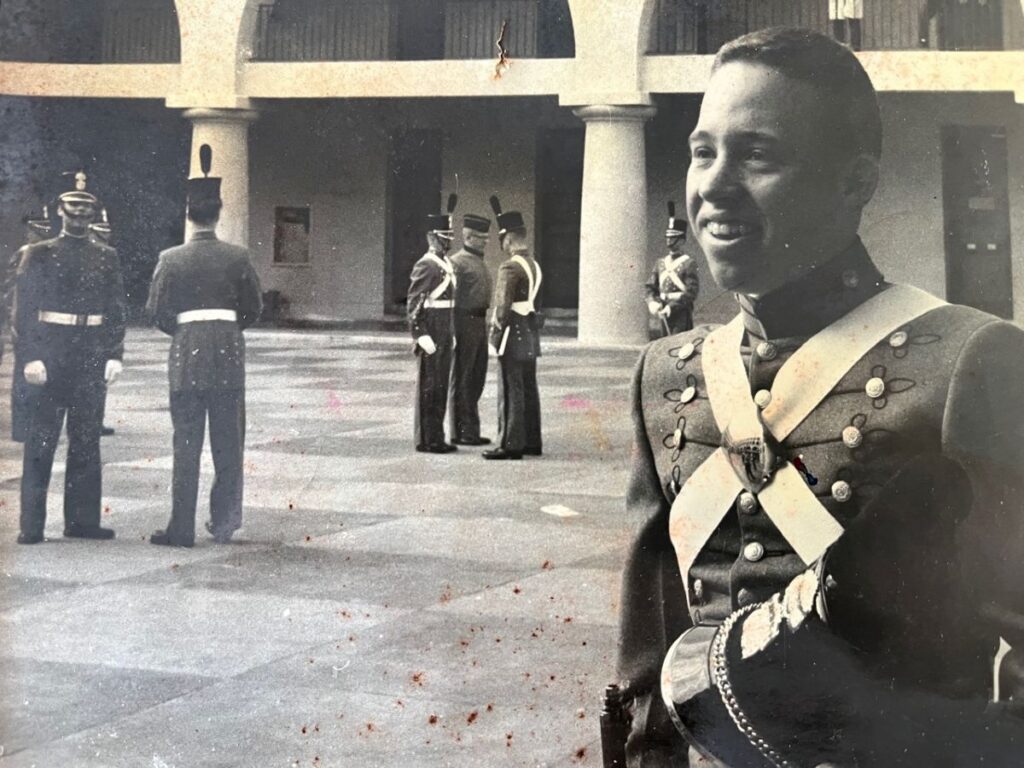
What I didn’t expect to find was the oral narrative of Joseph Trez who described the Fourth Class System in the 1960s — my time at the military school.
And if there is any fundamental question shared by every The Citadel graduate it is, “Was my plebe year as hellish as I remember?”
Trez says that in 1967 there were 17 different companies and “17 different cultures.” Some of those cultures were “fraternal,” some were “brutal,” and everything hinged on the Company Commander, the active duty (TAC) officer and the “things that upper-class rank holders experienced when they were knobs.”
Apparently there was enough hazing and abuse throughout the Corps to alert General Hugh P. Harris (Mark Clark’s successor) that something needed to be done to curb what was underway.
Many know I have written a column of some sort since the early 90s; and I have previously written about my own “plebe experience.”
In that regard, I have been clear that 1963-1964 was, by far, the worst time in my life. I kept a diary and, some of you know, questioned the usefulness and utility of that nine-month-long chamber of horrors, wondering how that time affected me in the long haul.
Trez says that General Harris knew something was seriously wrong and in 1968 created a commission to deal with the “racking;” sleep and food deprivation; late night “sweat parties” and all the rest that inevitably led to poor academic performance and mandatory summer school if one wanted to stick around.
“But did any of that behavior ever make an entry in the Post and Courier? I think history will show it didn’t. It certainly wasn’t on any TV program reporting abuses in the Forth Class System at The Citadel. It was Citadel introspection that there are problems and we needed to fix it.”
Trez graduated in 1969, went to the Infantry School at Fort Benning, Ga.; then Vietnam; and to Fort Bragg “in various command and staff assignments.” He came back to The Citadel in 1978 seeking an MBA and eventually getting a teaching job in the Army ROTC Department.
When he came back, The Citadel was courting Admiral James Stockdale, who had previously been a POW in Vietnam, “a Medal of Honor recipient and he had come to us from being the Superintendent of the Naval War College.”
“He received letters from the parents that described the brutality and hazing that their sons were experiencing, and the deprivation of sleep and food and he related to it as treatment that he and his fellow POWs received.”
“That just turned his stomach and he could not understand how this was happening at The Citadel.”
Stockdale formed his own Commission to change the System in 1979; and in this process sent a signal that academics were “priority number one” and Citadel would no longer be “wedded to traditions.”
“So, alumni members of the BOV (Board of Visitors) and a segment of the cadet corps … started fighting everything Stockdale did.
“Alums were apoplectic about what was happening in this report because it took out “racking” and it took out deprivation of food and sleep, and no upperclassman was (now) allowed in the freshman’s room during “study periods.”
The “alums” revolted against these changes and an incident — involving an upperclassmen pulling a .45 on a freshman — eventually led to Stockdale’s resignation.
Trez says this systemic self-examination was then, abruptly, interrupted with the arrival of Shannon Faulkner — the first woman seeking admission to The Citadel’s all-male ranks.
For at least a year, 1993, the crenelated fortress-like barracks on the Ashley River came into the cross-hairs of the American public overwhelming the alumni, the Board of Visitors and the cadets — all of whom believed women would be fatal to The Citadel’s brand.
When Trez again returned to the campus — now as Commandant of Cadets — he knew the hazing was still going on but that “toughness” was not the same as “leadership.”
Trez discovered that Pat Conroy’s novel, “The Lords of Discipline,” was on every cadet’s bookshelf — and that most cadets, even the women, believed that adversity, even the brutality as described by Conroy in “Lords,” were key ingredients for the making of The Citadel’s “Whole Man.”
In 1994, The Citadel got an unexpected injection of money, big money, from Bill and Gay Krause. Trez (and others) believed that earmarking this money for the study of Leadership, Ethics — especially Ethical Reasoning — was one way to repair the school’s tattered reputation.
The Krause Center would not be a symbolic, one-off stab at restoring decency; it would be a major academic element of the curriculum that would extend over the entire four years. It would involve a reading list — texts on moral crisis and conflicts of interest — guest speakers and meaningful “community service.” It would require buy-in from the faculty, Board of Visitors, the battered alumni and, of course, the cadets themselves. This effort would not, could not, be lipstick on a pig.
When I was a cadet, The Citadel’s actual purpose was to produce soldiers — in my case 2nd Lieutenants who would command rifle platoons in Vietnam. Now that role is to produce “Principled Leaders” who will enter the work force with a grounding in ethical reasoning taught over the entire four years.
Today’s Citadel graduates will not get a SEC-caliber football team. They will get lessons on courage and character. And yes, they will still read about the Battle of Thermopylae.
Scott Graber is a lawyer, novelist, veteran columnist and longtime resident of Port Royal. He can be reached at cscottgraber@gmail.com.