
University of South Carolina Beaufort
A groundbreaking article on ocean conservation published in Science Advances, one of the world’s premier peer-reviewed scientific journals, includes collaborators from the University of South Carolina Beaufort (USCB).
In the paper entitled “Communicating Coral: Art and Science for Global Reef Action,” a coalition of leading coral reef scientists and artists inspired by the natural world advocates for a new approach to coral conservation. They examine how creative expression can inspire public engagement, influence policy and mobilize conservation efforts for coral reefs and argue that art and science must work together to protect coral reefs from accelerating decline.
This collation includes USCB marine biologist Kim Ritchie, Ph.D., associate professor of art Joanna Angell, and artists Eveline Kolijn and April Flanders, all listed as contributing members of the Coral Art–Science Consortium, in collaboration with lead authors Mónica Medina, Or Ben-Zvi and Oren Levy. The Coral Art–Science Consortium is an international nonprofit organization that unites scientists and artists to protect coral reefs through storytelling, collaboration and environmental awareness.
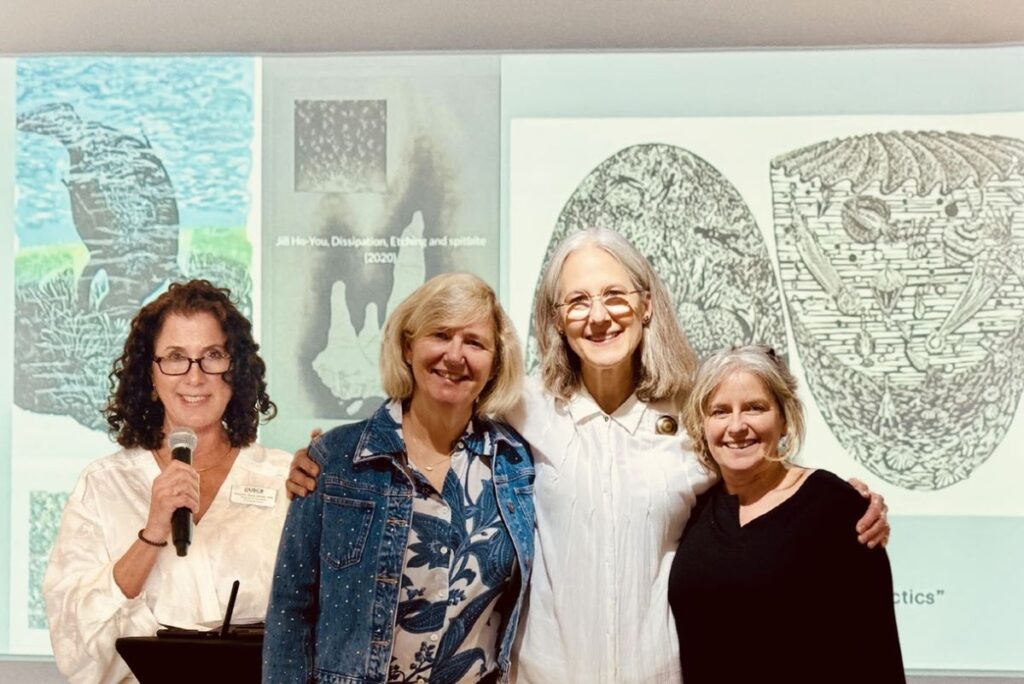
Ritchie is Associate Professor of Genetics and Prokaryotic Cell Biology at USCB and director of Pritchards Island Research. Angell teaches ceramics, drawing and printmaking and directs USCB’s Sea Islands Center Gallery. During residencies in 2025 on the university’s Beaufort campus and Pritchards Island, artists Kolijn and Flanders presented exhibitions entitled “Fragile Oceans,” “Tidalectics” and “Altered Environments.”
Coral reefs face growing threats from climate change, pollution, overfishing and coastal development. Once-rare mass bleaching events now occur frequently worldwide, endangering ecosystems that provide food security, coastal protection, cultural identity and livelihoods for hundreds of millions of people.
The publication argues that while science provides the data and strategies needed to conserve reefs, art has the unique ability to make those findings personal and emotionally compelling.
“Scientific research tells us what is happening to coral reefs worldwide and why it matters,” Ritchie said. “Art helps people connect with those findings on a human level. When people feel connected to coral reefs, they’re more likely to support actions needed to protect them.”
The article highlights art projects that have raised environmental awareness and suggests similar approaches to bring the underwater world into public view through sculpture, photography, film, fashion, graphic design, music, dance and immersive experiences.
Rather than simply documenting reef decline, the authors advocate artistic collaborations that make complex scientific concepts accessible to diverse audiences.
The publication also emphasizes including Indigenous communities and coastal populations whose cultures and livelihoods are deeply connected to coral reefs. By engaging local communities as collaborators rather than passive audiences, conservation efforts become more equitable, effective and sustainable.
Science Advances is a peer-reviewed, open-access scientific journal published by the American Association for the Advancement of Science (AAAS). The full article is available at https://www.science.org/journal/sciadv.