By Luke Frazier
The Island News
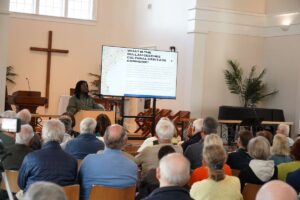
The Parish Church at Habersham is a relatively new building that was consecrated at the end of January last year. It’s a beautiful space with exposed wooden beams and windows that soar to the ceiling.
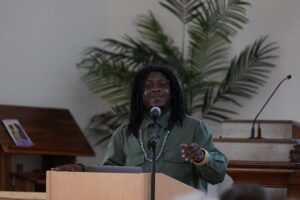
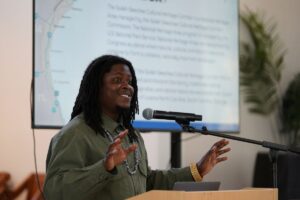
It might be a touch austere for certain tastes, but it was recently warmed up through an engaging lecture on Gullah Geechee culture by artist, historian, and memory worker Tendaji Bailey.
Bailey hails from Port Royal and has family throughout the Sea Islands. He is seventh generation Gullah Geechee and founder of the Gullah Geechee Futures Project.
He was invited to speak by Habersham’s history club, whose founder Annis Lyles says has one membership requirement — you must love history. Based on the 100-plus individuals who showed up recently for the late afternoon event, there is certainly plenty of interest.
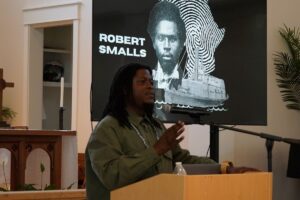
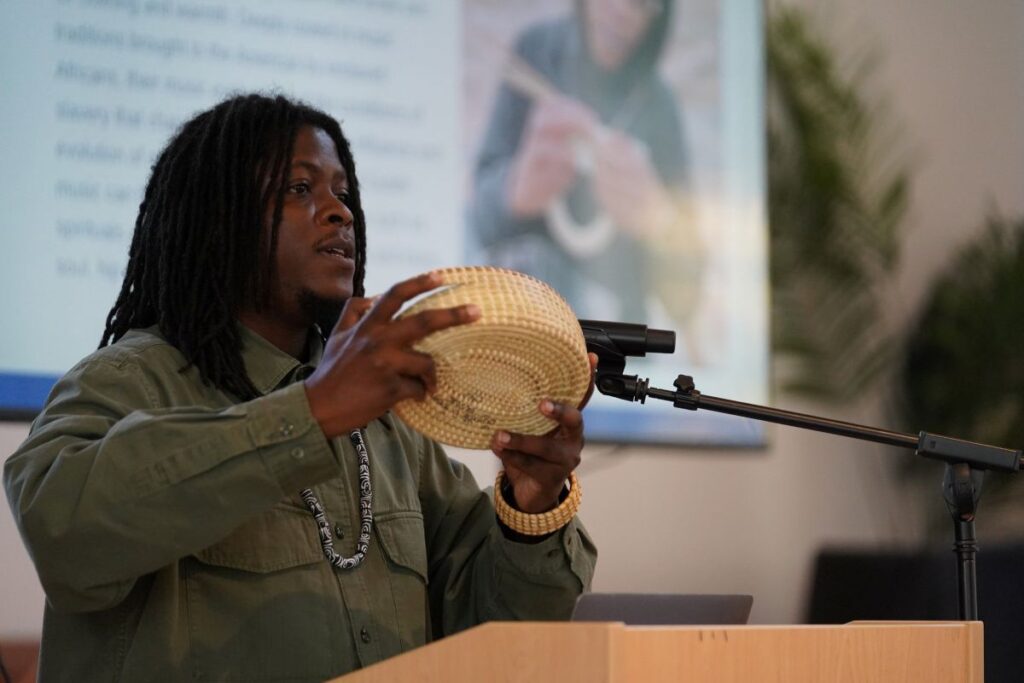
But calling what occurred a lecture isn’t quite right. When Bailey first strode to the lectern with a big smile on his face he didn’t say a word. Instead he broke into a richly voiced rendition of part of his original song Da Wada, in which he weaves in pieces of traditional hymns.
The song tells the story of the great paradox of the agony enslaved individuals endured during the Middle Passage voyages contrasted with the role coastal waters continue to play as an economic and spiritual life force for Gullah Geechee communities.
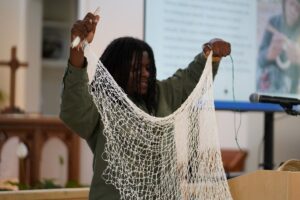
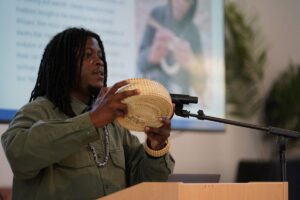
Bailey sprinkled in more song fragments from his collection “Seeking/Soaring: Gullah Resilience Songs,” which was funded by the South Carolina Arts Commission. His 75-minute presentation featured a variety of dramatic stories, pictures of family, community members, and mentors, and even a moment of show and tell that included a proud display of his in-progress handmade fishing net.
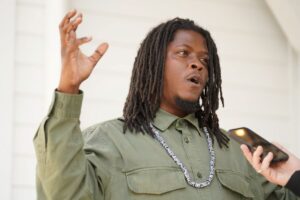
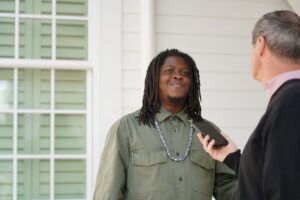
In a conversation prior to the lecture, Bailey explained that as a “memory worker,” he actively enters historical sites, performs rituals, and educates young people about the people and the foundational principles involved. He calls his work with the Gullah Geechee Futures Project a succession plan.
“It’s so important that we have a cadre of young people ready to step into those places,” he insisted, “[It’s an] intergenerational transference of knowledge, just to sit at these elders’ feet and hear the wisdom that they are so freely sharing.”
Other activities that Bailey uses when working with young people include gathering near the water at night to debrief painful history, for example after visiting the historic site of Igbo Landing on St. Simons Island, Ga.
This is where in 1803 a group of West Africans chose to walk in the water and drown rather than submit to slavery. It is also the source of the “Flying Africans” myth whereby the captives grew wings and flew back to Africa. Bailey is spellbinding during the presentation as he relates the various aspects of this historical event and many others.
As far as understanding the larger cultural context of the entire Gullah Geechee Corridor, roughly from Wilmington, N.C., south to Jacksonville, Fla., Bailey urges caution.
“Gullah Geechee Corridor is not a monolithic experience,” he says, “What it means to be Gullah Geechee on St. Helena’s Island is not what it means to be Gullah Geechee on Sapelo [Island] or Sandy Island. They all have their individual histories and experiences and icons who have been upholding legacies in these specific spaces.”
Bailey points out that the ties that bind distinct parts of the corridor are shared cultural experiences, water, and a connection to spirit through nature. He sees where he is today and what he does as being a direct result of exposure to a variety of these webs of historical significance and knowledge.
“I look at history as a window into your purpose,” he reflects, “It gives you clarity on what you are supposed to be doing once you have seen what has already been done.”
The question after the lecture might be whether some of the tough historical realities Bailey shared via stories and songs dampened enthusiasm for looking or sharpened resolve to see and understand even painful history. The type of history that includes the fact that for decades much of Beaufort County consisted of plantations routinely exploiting enslaved individuals, including the land where folks were gathered on this day to hear Bailey.
Part of the answer depends on how one might respond to Bailey’s plea found in his original song called “Joy.”
“Joy is a revolution, joy is a solution, c’mon let’s heal the world,” he sings, as he merges resilience with the fact of joy.
“So for me it’s important to know that the resilience of our ancestors was really birthed out of trauma,” Bailey concludes, “And the joy is that they were able to turn nothing into everything.”
On this recent afternoon Tendaji Bailey turned what was supposed to be just a lecture for a gathering of history lovers into a genuine truth-telling symphony.
Luke Frazier is a writer and award winning media producer who moved to the Lowcountry in 2024. He runs NOW Communications and can be reached at nowandfuturecomms@gmail.com.