
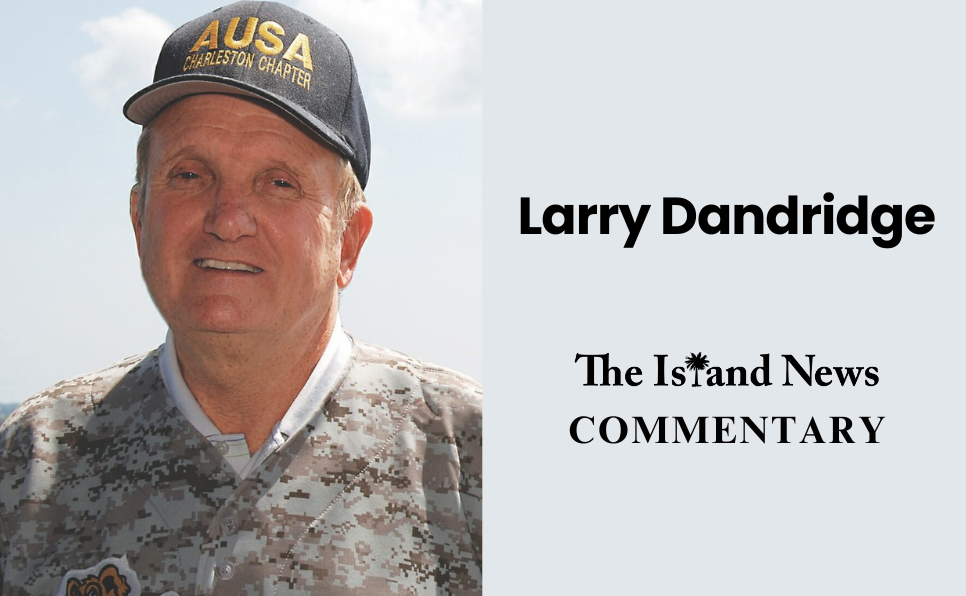
By Larry Dandridge
This is the first of four articles on why every eligible veteran should enroll in VA Healthcare. This article is based on my extensive experience as a patient and volunteer at the Ralph H. Johnson VA Medical Center & Healthcare System (RHJVAMC&HCS). Articles 2 through 4 will be fact-based and supported by scientific references.
I recommend VA Healthcare
As a Wounded Warrior and a service-connected 100% combat disabled veteran, I am fortunate to be in the highest priority group of veterans eligible for VA Healthcare. I am not fortunate to have been wounded three times in Vietnam and to have had a dozen Traumatic Brain Injuries, three in combat and nine in the line of duty training.
This columnist is a disabled veteran who uses VA Healthcare for most of my healthcare needs, including Primary, Orthopedic, Urology, Nephrology, Pain Management, Cardiac, Electrophysiology, Cardiology, Neurology, Mental Health (PTSD), and Dental care. However, because I am also a retired soldier and a 79-year-old, I also have Medicare and Tricare for Life Insurance that I can use instead of the VA.
Enroll in Medicare
I urge every veteran to enroll in Medicare when they become eligible, because VA benefits can change at the whims of an unreliable Congress and equally unstable Presidents, and if you wait to enroll after you become eligible, you will pay huge fines. There have been times when I used Medicare and Tri-Care for Life to obtain care from a civilian doctor and a private healthcare system. A veteran may also need a second, independent opinion to challenge a VA decision regarding service connection or other claim denial. Veterans may also wish to obtain an independent NEXUS letter to support a service-connected disability claim. More on this later.
Enrolling is easy
I found out that I could enroll in VA Healthcare by phone, by mail, in person at my local VA Medical Center or Community-Based Outpatient Clinic, online, and with the help of a VA-accredited VSO.
Use a VA-accredited Veterans Service Officer (VSO)
I started by reading the information at the VA “How to apply for your healthecare” webpage, asked my VSO to help me, and made an appointment with the Five-Star-rated Ralph H. Johnson VA Medical Center’s Eligibility and Enrollment Office, where I signed up for VA healthcare.
After signing up for VA Health Care and receiving a white background VA Identification Card with a bar code, my picture, and a member ID number, I made an appointment with my VA Primary Care Provider, who was the leader of my Primary Care Patient Aligned Care Team (PACT).
PACT Teams are great
I found out that my PACT Primary Care Provider could be a Physician, a Physician Assistant (PA), or a Nurse Practitioner (NP). My PACT Team consisted of (1) a Primary Care Provider, (2) a Clinical Pharmacist, a Registered Nurse (RN) Care Manager, (3) a Licensed Practical Nurse (LPN) or Medical Assistant (MA), (4) a Social Worker, (5) an Administrative Assistant/Clerk, and (6) me. I have had both Physicians and PA’s as my VA Primary Care Provider for 22 years now. They have each been highly skilled, knowledgeable, polite, understanding, kind, compassionate, patient, timely, and dedicated to providing the highest quality healthcare.
Know your PACT Team members/social worker
It is important for veterans to know the name and contact information of their PACT Team members, especially their provider, RN, and social worker. The key role the PACT Team social worker played became evident to me quickly when I needed to help an elderly veteran’s spouse and family obtain a referral to the Fisher House Charleston while their loved one was an inpatient at the VA medical center. The elderly veteran’s PACT Team social worker was also needed to help the veteran understand the robust VA benefits available to elderly veterans, including Aid and Attendance, Housebound, Geriatrics, Long-Term Care, Home-Based and Community Services, and Nursing Home and Residential Care.
Summary of my experience
In summary, I have found VA Healthcare to be second to none at the Ralph H. Johnson VA Medical Center and Healthcare System (RHJVAMCHCS) and its North Charleston Community-Based Outpatient Clinic. My appointments were always scheduled within 30 days, often much sooner, and my doctors were always on time. If the VA could not see me in a timely fashion, I was offered to see a Civilian Doctor through the Community Care Program. And I got a phone call, a letter, a phone message, and a My HealtheVet message reminding me of my appointments. From 2004 to 2026, I was not only a patient there but also a volunteer Patient Advisor.
As a Patient Advisor, I served on the Customer Service Council (later Patient Experience Council), the Patient and Family Centered Care Committee (PFAC1), the Patient and Family Advisory Council (PFAC2), the High Reliability Council (Lean Six Sigma Black Belt), and the Stakeholders’ Committee. I have also served as an Employment Assistance Advisor and a Continuous Improvement Advisor to the RHJVAMCHCS and as an Ambassador of Goodwill for Fisher House Charleston.
In these roles, I saw my primary job to be a “junk yard dog” looking for veterans and their family members and other customers who were unhappy with the services of the Ralph H. Johnson Health System and latch on to the problem (like a junk yard dog and not let go), help identify the problem, find the root causes of the problem, find counter measures (fixes) for the problem, help the RHJVAMCHCS implement the fixes/countermeasures, and then hold on to those fixes so that the problem does not come back.
I played a small role in solving the huge, frustrating parking problem (Parking garage, valet parking, parking near Porter-West Ashley, moving clinics off campus, after-hour services, etc.), the terrible lack of lodging/transport for families (Fisher House & Friends of Fisher House Charleston), the awful lack of funds/jobs for OIF/OEF veterans (Establishing Employment Assistance Officers, Establishing the AUSA Wounded/Injured Fund, Giving same-day grants, Job Assistance Programs, etc.), and hundreds of other mostly small problems.
So today, the Coastal areas of South Carolina and Georgia have a VA Medical System that is a world-class operation and team. Yes, like all big operations, it still has problems, bottlenecks, phones that are not answered fast enough, phones that veterans have to leave messages at (rather than talk to a real person), and staff shortages, but for the most part, it is perhaps the best medical system in the world.
Continued next week.
Larry Dandridge is a Vietnam War wounded warrior, a combat and 100% service-connected disabled veteran, an ex-Enlisted Infantryman, an ex-Warrant Officer Pilot, and a retired Lt. Colonel. He is a former Veterans Service Officer, a Patient Adviser at the RHJ VA and Durham VA Medical Centers, a Fisher House Charleston Goodwill Ambassador, and the Veteran Benefits Advisor for the AUSA Coastal Carolina Chapter, MOPH Chapter, MOAA Triangle Chapter, and VFW Post 7383. Larry is also the author of the award-winning Blades of Thunder (Book One) and a contributing freelance writer with the Island News. Contact him at LDandridge@earthlink.net or 843-276-7164.