
By Scott Graber and Lolita Huckaby
The Island News
For those who often travel north from the Lowcountry on I-95, they know Rocky Mount, N.C.’s Exit 138 signifies one is about halfway to Washington, D.C.
There is no reason to stop, or eat, unless one departs Beaufort around 8 a.m., and is now craving the vinegar-based barbecue available at Gardner’s. Some may even remember Bob Melton’s former barbecue place, hard by the Tar River, knowing that nothing will ever match the taste and texture of Melton’s “whole hog,” 18 hours-in-the-pit recipe.
In the late 1800s Rocky Mount, N.C., was a major hub for “open auction” tobacco sales. When the town’s massive brick buildings were not being used to auction-off tobacco, entertainers like Count Basie and Kay Keyser played their music for thousands of well-heeled farmers and their dancing sons and daughters.
In addition to tobacco, Rocky Mount was where the Atlantic Coast Line Railroad repaired their huge, 2,000-horsepower engines. If you didn’t have a tobacco farm, you were lucky to have lifetime employment keeping the EMD E3 (501) operational and running between New York City and Miami.
But that’s in the past. Lately Rocky Mount has not been doing well. Not at all.
A recent investigative piece in the Charleston Post and Courier on municipal corruption and incompetence featured the town of Rocky Mount for its cover story, as a “model of local government failure.”
The series, entitled “Townfall: Many South Carolina towns are broken, plagued by infighting, corruption and mismanagement,” actually focused on 70-plus municipalities in the Palmetto State as examples of what happens when there are no regular audits, no stringent oversight or experienced financial officers
Luckily, Beaufort County nor any of its municipalities make this list.
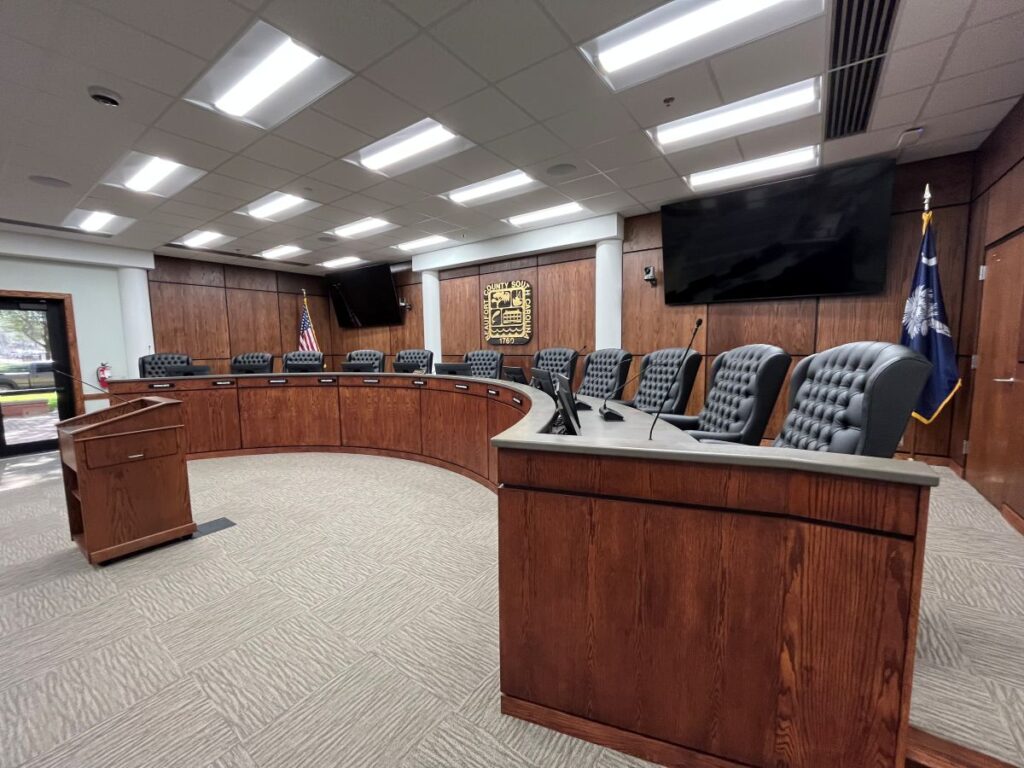
But recently, Beaufort County Treasurer Maria Walls, herself an elected official, stood up at the May 26 County Council meeting and reminded the elected officials there had been eight county administrators, six chief financial officers, five deputy administrators and four county attorneys in the past nine years.
Shouldn’t that have been a red flag something is wrong?
Walls, who was first elected in 2015 and is up for re-election this year, was using her time at the podium to justify her request for extra budget increases for her staff, a request she eventually won. But to reach her goal, she also argued that administrative instability is creating problems for the government operation.
The current council knows very well about Walls’ accusations of “instability” since for at least the past four years they’ve spent hours and hours behind closed doors, with their various attorneys talking about personnel issues dealing with administrative staff.
Administrator Michael Moore, a former naval aviator with extensive military experience, started work for Beaufort County in July 2024 after almost four years as assistant county administrator in York County, S.C.
He inherited the administration of Eric Greenway, who was fired by the County Council in June 2023 after two years in the top position and months of whistle-blowers’ accusations.
There is the ongoing investigation into possible wrongdoing during the Greenway administration, which has not been concluded by the state Attorney General’s office. The AG’s involvement came at the request of the state’s Public Integrity Unit under the First and 14th District Solicitors’offices.
And in December 2025, the County Council voted to hire the outside firm Bettis Law Group of Columbia, S.C. to determine where staff leaks were coming from. No individuals were identified but procedural changes to employee handbook were made.
Earlier this month after meeting for several hours in closed session, the council unanimously voted to hire an outside firm to review the operations of departments and personnel overseen by Moore.
This comes as, two months ago, in the middle of the FY 2027 budget discussions, Chief Financial Officer Pinky Harriott, who was promoted from budget director in November 2024, left. No explanation has been offered as to whether she left or was fired.
This all with the guidance of the council’s own law firm, Howell, Gibson and Hughes, which they agreed to hire earlier this year in addition to the county’s in-house three-lawyer legal department.
Since CFO Harriott left, the council has continued to meet in closed session “to discuss matters covered by attorney-client privilege and to discuss issues related to the employment of a person regulated by the council.”
All from County Council members who often use the word “transparency” and their desire for such; but still hire outside law firms and still use “attorney-client privilege” that keeps its citizens from knowing the exact nature of the problem plaguing Council.
So what’s the problem?
One speculation as to the cause of this “instability” charge most recently leveled by Treasurer Walls is that part of the problem running through the entire county operation is a top-heavy administration, several of whom have been with the organization for some time, accustomed to running their departments “their way.”
Employee morale, according to some, is at a rock-bottom-of-the-barrel low, which never leads to good operations.
Word is that Administrator Moore was brought in by the council to make changes, to “clean house.”
But because apparently that hasn’t happened, at least not to the satisfaction of some council members, Moore himself may be on the hot spot with this latest “outside” study.
The results of this study are reportedly expected in the next 10 days, and with an election coming up in three months.
That election, impacting seven seats on the 11-member council, may well change the arithmetic of any solution. At this writing two members have already lost their seats in primaries and three others have chosen not to run again. All of which means five members of County Council will be new to these internal problems.
But will the results of the new study be made public? Will the County debate the changes in public? When will the public be made aware of extent of the problems?
And all this is taking place as county voters – again, those paying the bills – will be asked in November to support a one percent sales tax designed to raise up to $780 million over a nine-year period for road improvements.
One thing for sure, Beaufort County voters rejected a one percent transportation sales tax two years ago, largely because they said significant projects outlined in the 2018 sales tax referendum had not been accomplished.
Recently Charleston County Council agreed to put a half-percent sales tax referendum on their November ballot. Among their list of projects to be funded was the extension of an existing floodwall to protect the downtown Charleston Peninsula from rising waters.
The floodwall is the kind of tangible, touchable project that appeals to many voters. It’s the kind of project Beaufort County planners and engineers need to be able to point to if they hope to win voter support for road improvements that are obviously needed.
Beaufort County Council needs to tread lightly in the next few weeks with this latest “study” and how it is handled. In January, when the next County Council is sworn in and a new chairman and vice-chair will be selected to steer this merry group of 11, will there be “change?”
There will be a new sheriff, for sure, with P.J. Tanner handling over the law enforcement reins after 28 years with a department grown to 245 sworn deputies and a budget of $32 million.
At the moment the Beaufort County Council members are spending a lot of time in closed door meetings and not saying much publicly, keeping their proverbial cards close to their chest.
Their response, as well as that of the voters, may be, a part of the national anti-government sentiment which seems to be in full flower across the country.
While Beaufort County is not on that list of South Carolina local governments deemed a “failure,” it’s hard to imagine voters giving these elected officials another sales-tax penny earmarked for needed road and intersection improvements in this corner of the Lowcountry.
Scott Graber is a lawyer, novelist, veteran columnist and longtime resident of Port Royal. He can be reached at cscottgraber@gmail.com.
Lolita Huckaby Watson is a community volunteer and newspaper columnist. In her former role as a reporter with The Beaufort Gazette, The Savannah Morning News, Bluffton Today and Beaufort Today, she prided herself in trying to stay neutral and unbiased. As a columnist, these are her opinions. Her goal is to be factual but opinionated, based on her own observations. Feel free to contact her at bftbay@gmail.com.