
Ability of Beaufort County to protect the Gullah/Geechee lifestyle using an ordinance that prohibits golf courses remains in play
By Scott Graber and Lolita Huckaby
The Island News
For those who care about the history of this particular piece of Lowcountry paradise, it’s more than ironic that golf courses, usually a recreational attraction, have become a political hot potato.
Historians generally consider 1514 the date of Beaufort’s initial discovery by European outsiders. But contemporary historians point to the mid-1950’s when Charles Fraser, founder of Sea Pines Plantation, looked around for ways to entice buyers to his Hilton Head Island development and golf courses were one of the answers.
Fraser’s idea for first-class golf courses marketed with second home developments and resort living spread across Hilton Head and across the river to Bluffton and northern Beaufort County.
That golf-course fueled development sparked development in Jasper County with the arrival of Del Webb’s Sun City Hilton Head in 1994, turning the vast, untouched pine forests of Jasper County into the fastest growing county in the United States.
While some consider all this development, which has pumped Beaufort County’s average income level of $90,509, an economic blessing, others consider it a cautionary tale.
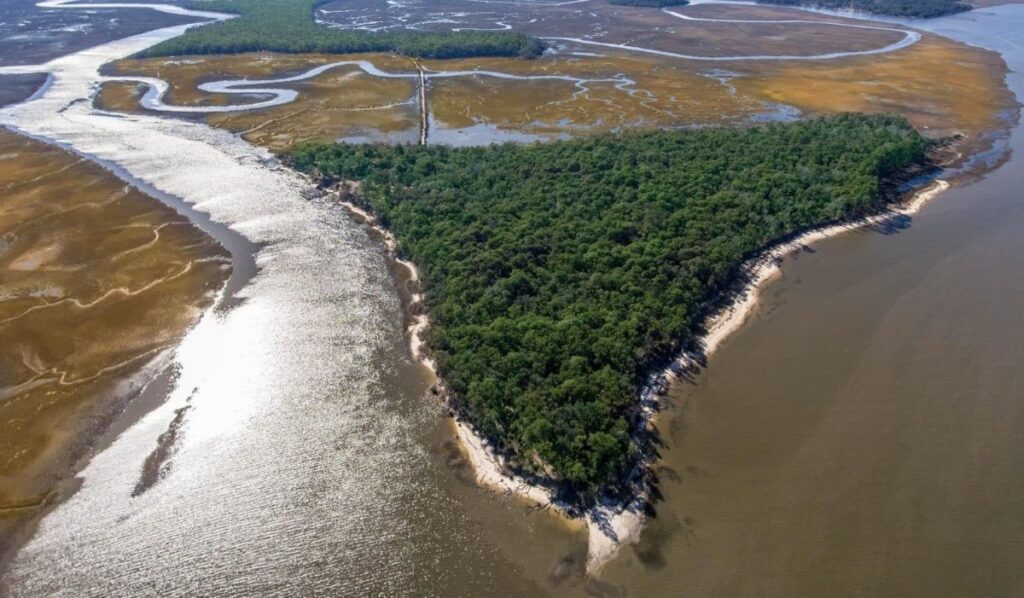
When Pine Island Property Holdings LLC bought 502 acres of land on St Helena Island in 2023 and announced it intended to build a golf course-based residential resort, complete with guard gates, there was alarm throughout northern Beaufort County. It was loudest on St Helena Island, a rural, largely African American community except, primarily, for the enclave of Dataw Island purchased by ALCOA in 1983 for residential development which offers approximately 1,100 total property lots and two 18-hole golf courses.
It wasn’t long within the Pine Island permitting development process, that citizens’ opposition began to include the charge, “we don’t want to become Hilton Head Island.”


It wasn’t the purchase of Pine Island that brought county residents to the planning table. There was a growing concern that rural areas of the county were more and more attractive to developers, with some property owners eager to accommodate the number of residents moving to the area, both as military personnel assigned to Parris Island Marine Corps Recruit Training Depot and the Marine Corps Air Station and retirees.
Those concerned citizens began in the late 1990’s to work on the county’s Comprehensive Development Plan to include special zones, Cultural Protection Overlay (CPO) districts, to protect the rural character of their neighborhoods from the resort-like communities spreading south of the Broad River, causing land prices – and taxes – to rise and force some individuals off their property.
According to lawsuits filed on the matter, when Pine Island Holdings LLC representative Elvio Tropeano brought his proposed plans for the isolated property at the northern tip of St. Helena Island, his initial meetings with then-County Administrator Eric Greenway, led to general agreement that his proposal for three six-hole golf courses, instead of 18 holes, would pass muster with the county planners and County Council, which would have to approve a zoning change.
The County is now in a three-year legal battle whose next skirmish is expected to take place in the second week of December in Richmond, Va., when oral arguments are scheduled on the appeal of the first of two federal lawsuits filed by the Pine Island developers.
Pine Island brought this initial lawsuit in 2023, challenging the constitutionality of the CPO and, further, claimed damages.
U.S. District Court Judge Richard Gergel dismissed the claim in February of this year, declaring it moot since it was focused on obtaining approval of three, six-hole golf courses as opposed to a single, 18 hole golf course. By this point, Pine Island developers had officially withdrawn those plans from county consideration.
Federal lawsuit No. 2
In April of this year, a second lawsuit was filed by Pine Island Holdings in federal court, alleging the county’s current version of the Cultural Protection Overlay, the CPO, is “race-based zoning that deprives the Plaintiffs of an economic use of their land. …”
The suit alleges “the County has enacted and is enforcing a race-conscious zoning scheme which, explicitly prohibits otherwise productive land uses for the stated purpose of preservation of the Gullah/Geechee people. …
“It is the CPO that turns permitted uses into prohibited ones for the alleged purpose of protecting and favoring members of one racial class at the inherent expense of others.” the Complaint reads.
The Pine Island Complaint is lengthy – 69 pages with 386 numbered paragraphs – but in the end it says what Beaufort County did with the CPO were violations of the Equal Protection Clause of the14th Amendment.
There is a certain irony in that the 14th Amendment, adopted by Congress in July,1868, was enacted to protect the newly freed slaves from the “Black Codes” that basically denied civil rights to African Americans particularly those in the South.
The complaint includes six separate “counts” or violations of the Equal Protection Clause: the CPO “employs an express racial classification”; the County has permitted golf courses in comparable overlays; the County has approved three other properties that meet the prohibited “resort” or “gated community” definition; the CPO is vague; the County failed to give the Plaintiffs either procedural or substantive due process.
The Complaint uses the terms “race-conscious zoning”, “race-associated cultural identity” and “race-based prohibitions” throughout, alleging that “preserving demographic segregation of St Helena Island in the name of ‘cultural protection’ is not a compelling government interest.”
Beaufort responded saying the Complaint “fails to allege any facts establishing that Plaintiffs have suffered a concrete and particularized injury attributable to racial discrimination.”
The bulk of the county’s response consists primarily of denials of the specific allegations made by Pine Island. But there are other responses, however, that shed light on the County’s position in dealing with these challenges:
Developers claim: on August 28, 2023, Pine Island was “specifically advised to subdivide the property into three (3) 6-hole golf courses” by County officials, including former county manager Eric Greenway, Assistant County Administrator Whitney Richland, county attorney Tom Keaveny, and Special Assistant to the County Administrator, Hank Amundson, all no longer with the county.
At that point “Plaintiff closed the purchase of the Property.”
County response: “the Plaintiffs had no right to reasonable reliance on any statements by individuals of limited authority that three golf courses of six holes each could be developed.”
Developers claim: “elsewhere in Beaufort County, golf courses are permitted in overlay districts for comparable purposes.” They point to the Daufuskie Island overlay and the Coosaw Island overlay as places where golf courses are permitted.
County response: “the County asserts that not all overlay districts are the same and that permissible land uses for the overlay districts may vary depending on the district.”
Developers claim: “selective enforcement” of the CPO noting Orange Grove Plantation, a family owned event venue, Yard Farm RV Resort (permitted but not constructed) and Penn Center, all of St. Helena Island and within the CPO, are entities that operate “resorts” or “gated communities.”
County response: Orange Grove and Yard Farm RV Resort Properties involve uses that are permitted in the CPO, and Penn Center provides uses that pre-existed adoption of the CPO.
Developers claim: County Councilmember York Glover, who represents the St. Helena district, reportedly stated, “one or our first priorities was to focus on Pine Island” describing Plaintiff’s intended development “as a little yeast out there that we need to destroy.”
County response: An individual council member “is one individual member of eleven elected members of the County council, that he is entitled to his personal and political opinions, and that his statement cannot be considered as the policy of opinion of the County council as a whole. …”
Developers claim: the September 22, 2025 public hearing was changed from the Buckwalter Recreation Center in Bluffton to the Burton Wells Recreation Center in Burton and “the relocation materially altered the conditions of public participation.”
“While Bluffton provided geographically balance access across the County, the venue change placed the hearing in closer proximity to constituencies aligned with organized opposition to Plaintiffs proposal.”
County response: admits only that the Council meeting was held at the Burton Wells Recreation Center.
Damages
The developers, who in the first lawsuit did not ask for damages, this time asked for damages created by environmental studies, legal costs, increased construction costs and “expenses that would not have been incurred but for the challenged conduct.”
While a specific dollar figure for these alleged damages is not included, the suit claims “plaintiffs have incurred millions of dollars in expenses attempting to resolve the unlawful application of the CPO and exhausting administrative remedies.”
This request, in tandem with the request for a jury trial means that calculations will be presented to the jury at some point and, subject to the jurors’ life experience and emotions, could result in an outcome that will be hard to predict.
Settlement?
With the possibility of facing a jury trial at some point, pressure on both parties to settle before trial becomes a factor. In that light, it’s been reported a settlement offer from the developers was expected to be presented to Council as recently as Sept. 28, in closed-door session with the Pine Island’s legal counsel also in the room.
When it became known that Pine Island’s legal counsel would be included in that session, council members objected and the issue was removed from the closed-door session’s agenda.
The developers, in earlier discussions with the Council, had offered roughly $7.8 million to local entities including:
— $3.47 million to the Beaufort-Jasper Housing Trust;
— $2.5 million to the Coastal Community Foundation;
— $1 million for boat landing renovation and a highway turn lane;
— $600,000 to the Gullah Geechee Cultural Center;
— $150,000 for heirs property mitigation;
— $75,000 toward a historical cemetery survey;
— 1% sales tax fee on future property sales.
What’s next?
County lawyers were able to delay proceedings in this most current federal matter until the appeal by developers is heard in the first federal lawsuit. Currently oral arguments in that appeal case are scheduled for Dec. 8-11 in Richmond, Va.
In the meantime, Tropeano has permission from the county to build a 20-home residential subdivision on a part of Pine Island along Village Creek.
Timbering and land clearing for this 65-acre parcel is already under way.
On Jan. 1, five new people will join the 11-member County Council. The Council will elect a new chairman to steer their course.
But it’s a surety that one of the first issues on their plate will be Pine Island’s development plans with an 18-hole golf course and whether to continue the fight to protect the embattled Cultural Protection Overlay.
What’s at stake
It is clear the sea island culture is far different than the 1930s landscape described by W. T. Woofter, southern sociologist working for the WPA in “Black Yeomanry: Life on St. Helena Island.”
“Africa is here. Physical traits, and doubtless many subtler cultural traits, are African. Down the road from the house goes a straight-backed girl balancing a bucket of water on her head with a natural grace possible only to Africans. Here stands Aunt Rose with her present of eggs, welcoming us exactly as we would be welcomed in Nigeria. The continent of mystery is woven through the folklore and superstition and throbs in the specific shouts of the praise houses. These, however are incidental. There is astonishingly little from Africa which is of functional importance in the present day activities of this isolated Negro culture.
“Old England and early America are here in the songs and the dialect which fall so strangely on the ear, in the ox-drawn, two wheeled carts which we so frequently pass, in the yeoman culture of small plots of land with its independent life not fashioned after a money economy. …”
Most of this lifestyle is long gone. However, the fate of this government regulation, the CPO, remains on the table.
The question of whether Beaufort County can protect small farms, landscapes open to the public or the Gullah/Geechee lifestyles using an ordinance that prohibits golf courses, remains in play.
Scott Graber is a lawyer, novelist, veteran columnist and longtime resident of Port Royal. He can be reached at cscottgraber@gmail.com.
Lolita Huckaby Watson is a community volunteer and newspaper columnist. In her former role as a reporter with The Beaufort Gazette, The Savannah Morning News, Bluffton Today and Beaufort Today, she prided herself in trying to stay neutral and unbiased. As a columnist, these are her opinions. Her goal is to be factual but opinionated, based on her own observations. Feel free to contact her at bftbay@gmail.com.