
By Jessica Holdman and Sienna Adcox
SCDailyGazette.com
COLUMBIA — A GOP push to overhaul South Carolina’s congressional map ended Tuesday, May 26, as a record-setting start to early voting prompted Republican senators to abandon their support.
The 26-18 vote to effectively kill the bill requested by the White House included 14 Republicans.
It followed one of the chamber’s most conservative members taking the podium to explain why he could no longer support the effort, 12 days after the start of a special session ordered by Gov. Henry McMaster.
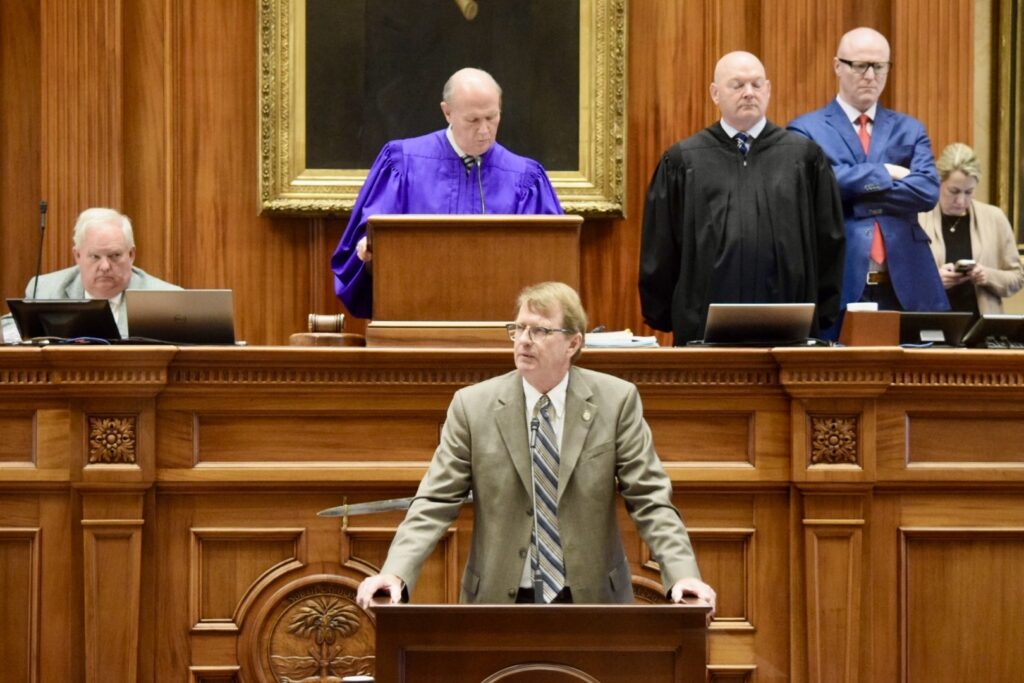
“Neither my conscience nor my common sense will allow me to stop an election underway,” said Sen. Richard Cash of Anderson County. “The deadline is past. Voting has begun. It is time to conclude the matter.”
By noon Tuesday, 26,000 South Carolinians had voted in person. That’s more than the total for the first day of early voting in 2024. The tally rose to 32,300 an hour later. In addition, more than 4,100 mailed absentee ballots had been returned by Tuesday, according to the state Election Commission.
Recognizing that Republicans will be angry at the Senate, Cash stressed that the fastest the bill could become law would be sometime Wednesday, after many more thousands of people will have voted. The only way it could have passed sooner was if at least 31 senators — a two-thirds supermajority — had voted Friday to ignore the chamber’s rules for redistricting debates. But that motion failed twice.
Following the rule of law is a foundational principle for the nation, Cash said, adding “I’ll emphasize it’s also a bedrock principle of conservatism.”
He then joined 11 other Republicans in defeating a motion to limit debate as per Senate rules for the final necessary vote — which still would have required dispensing with nearly 140 proposed amendments and giving each senator an hour to talk.
That’s why Wednesday was the earliest the bill could pass. That motion, for what’s called cloture, needed three-fifths majority approval (26). It failed on a 20-24 vote, which meant debate could continue indefinitely. Instead, it signaled the end. The vote that killed the bill came 15 minutes later.
Early voting continues through June 5. The legislation would have delayed party primaries for South Carolina’s seven U.S. House seats until August, while keeping other contests on schedule. When precincts closed June 9, any votes cast for congressional candidates would not have counted.
‘They’re angry’
The White House-endorsed map would have put more than 1.5 million South Carolinians old enough to vote in a different congressional district.
There is no precedent in state history of the voting lines changing after voting started, Cash said, noting he’d asked staff to research the question.
Senate Minority Leader Brad Hutto called the bill’s demise “a victory for the people of South Carolina, who let it be known to everybody that their vote matters — their vote counts.
“It was the people,” Hutto told reporters after session adjourned. “When they got up this morning, normally they would have gone to work, taken their kids to daycare, maybe gone on vacation, but they didn’t today. They went out to their early voting places, and they did so in ways that we have not seen before.”
The Orangeburg Democrat also called it the latest example of “South Carolina standing up to be South Carolina,” a state known for its rebellious nature.
“You go back anywhere in history, we’re just generally not a state that gets pushed around by Washington,” Hutto said.
People who voted in the opening hours included at least a dozen senators. Senators wearing stickers to show they’d voted ahead of the session’s 11 a.m. start included several Republicans.
After standing in line with voters in Newberry ahead of polls opening at 8:30 a.m., Sen. Ronnie Cromer of Prosperity was among the Republicans who switched from “yes” to “no” on Tuesday.
“People will vote when they’re angry, and I think what we’re seeing today across the state, with the record early voting turnout, is that we’ve made some people mad,” said Senate Majority Leader Shane Massey, who has consistently opposed the effort over the last two weeks. “Even having this conversation has upset a lot of South Carolinians, because they think that we’re cheating.”
The Edgefield Republican hopes voter anger won’t continue into the general election. He has repeatedly warned his colleagues that a map aimed at flipping South Carolina’s only blue U.S. House seat could backfire and create competitive seats for Democrats.
“My hope is that we have a big Republican push to try to counter that in November or else there’s going to be some losses, especially some down-ballot losses among Republicans,” Massey said.
The catalyst
The effort in South Carolina started after the U.S. Supreme Court ruled April 29 that Louisiana’s 2024 congressional map, which created a second majority-Black district, was an unconstitutional racial gerrymander. President Donald Trump asked the Legislature’s GOP leaders to look at the ruling and South Carolina’s map. Trump called legislators personally, called in to at least one GOP caucus meeting, and urged an overhaul through social media posts.
A day after Republicans in the state House pushed through a resolution to consider an overhaul, a map created by the National Republican Redistricting Trust circulated in the chamber. The House passed the legislation last week that drew U.S. Rep. Jim Clyburn out of the district he’s represented since 1992.
Supporters argued the 6th District, which was drawn 34 years ago to create a majority-minority district, needed to be “un-gerrymandered.”
But opponents countered there was no need to upend the June primaries: South Carolina’s congressional map has been upheld by both the U.S. and state supreme courts as a partisan gerrymander — drawn in 2021 to keep the coastal 1st District safe for Republicans.
Plus, South Carolina no longer has a majority-minority district. Due to population changes and decennial redistricting cycles since 1992, the percentage of Black residents in the 6th District has fallen to less than half.
‘Rife with errors’
If the map handed down from Washington had become law, a lawsuit challenging the timing was guaranteed.
Republican opponents in the chamber have repeatedly said the map would likely get struck down by the state Supreme Court because of the rushed process. The record in the Legislature of its creation involved less than 8 minutes of testimony from the drawer of the map, Adam Kincaid, who spoke virtually at a House subcommittee hearing. He did not address senators during a day-long hearing last week.
“Our record is 7 minutes 40 seconds talking to the House via Zoom. That’s our record! No questions, no demographic analysis,” Sen. Tom Davis, R-Beaufort, said Tuesday in explaining his “no” votes. “I’m stunned — stunned — something like this” advanced as far as it did in the Senate.
“Something completely unvetted — something we had no role in shaping,” he continued, “it should come as no surprise that it’s rife with errors. Not only are precincts split, you have precincts that no longer exist.”
And yet, senators were being pressured to pass it without making any changes that would require the House to come back and take a final vote.
“God forbid we try to fix it,” Davis said. “It’s more important to pass a bad map we know is flawed than to try to fix it.”
After chastising Republicans for being willing to cede the state’s 10th Amendment sovereignty to Washington, he called for the vote to end the debate.
The special session that began May 15 marked only the second time in 25 years that the Legislature returned by order of the governor. After the vote, McMaster said it’s time to move on.
“I am confident that one day South Carolina’s congressional delegation will be completely Republican,” the Republican governor said in a statement. “I am disappointed that day has not yet come.”
He encouraged South Carolinians to “exercise their precious right to vote, especially during this 250th anniversary of the Declaration of Independence.”
And he reminded legislators they still need to return to finish their work on the state budget for the fiscal year starting July 1. Before leaving Tuesday, senators set June 10 as their next day in session to wrap up work on the state spending plan.
Jessica Holdman writes about the economy, workforce and higher education. Before joining the S.C. Daily Gazette, she was a business reporter for The Post and Courier.
Seanna Adcox is a South Carolina native with three decades of reporting experience. After covering the S.C. Legislature and state politics for 18 years. she launched the S.C. Daily Gazette in November 2023 as the 37th state affiliate under the States Newsroom umbrella. Her previous employers include The Post and Courier and The Associated Press.
S.C. Daily Gazette is part of States Newsroom, the nation’s largest state-focused nonprofit news organization.