
By Kevin de L’Aigle
This week, I decided to take a break from grumbling about the pollen and doom-scrolling on my phone and take a warm-day walk with our rescue dog, Buddy, over to spend a little time in the hallowed ground of the Tabernacle Baptist Church churchyard.
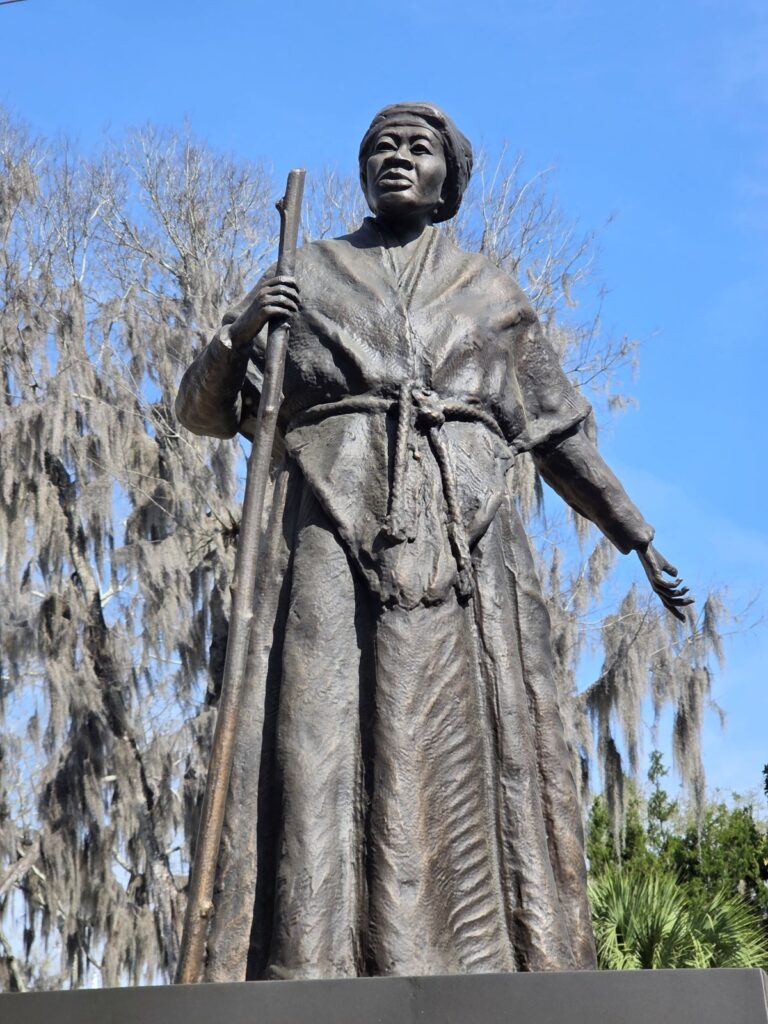
As I stood there looking up at the pollen dusted bronze monument to Harriet Tubman and those she led out of slavery, a tour group from the Reconstruction National Historic Park passed by. I was reminded of the legacy of Harriet Tubman, who died 113 years ago on March 10, 1913 — Harriet Tubman Day.
When Tubman was an enslaved child, an overseer hit her on the head with a weight after she refused to restrain a fellow enslaved man who was attempting to flee. She suffered severe trauma from the event and experienced headaches, seizures and “visions,” or hallucinations, that she interpreted as inspiration from God to help guide her work and strategy.

By the late 1890s, the pain had affected her ability to sleep, and she found a doctor in Boston willing to operate on her brain. Instead of receiving anesthesia while the doctor cut open her skull and performed the surgery, she chose to bite on a bullet — something she had seen soldiers do during the Civil War when they suffered injury on the battlefield.
I think about how we all struggle with some kind of mental health struggle over the course of our lives, and the awesome courage it took for Tubman to turn her disability into her superpower.
In today’s era of “might makes right,” it is interesting to see how power and vulnerability can work together and accomplish extraordinary things. When Harriet Tubman was doing her amazing work in our world, she was likely able to remain fairly safely unseen. Tubman was able to slip in and out of spaces often unseen because those around her didn’t expect an “ordinary” person like her to have the ability to do anything extraordinary.
Today, as we cross the Harriet Tubman Bridge on U.S. 17, we remember that on June 2, 1863, Tubman led 150 African American Union Soldiers in the Combahee River Raid, an operation that rescued more than 750 men, women and children, according to the Reconstruction National Historic Park.
The Raid was the only Civil War action ever organized by a female civilian. During the Civil War Tubman served as a nurse and Union informant, using the navigation skills that she developed during her time as a conductor on the Underground Railroad.
Tubman, already familiar with the terrain and waters during resistance activities in the region, helped plan raids and organized reconnaissance expeditions. Tubman conducted 19 trips from different areas of the South to Ontario, Canada.
She famously stated, “I never ran my train off the track and I never lost a passenger.”
Tubman, also known as “Moses” for her role in delivering her people from slavery, is recognized as a saint in the Episcopal Church, having been formally added to its calendar of feast days in 1997. The Military Intelligence Corps inducted Tubman into its Hall of Fame in June 2021, and hopefully someday we will have a $20 bill featuring her image.
“I have no doubt that she heard all her life with a small stature and being a woman and an African American, what she could not do,” 45th Army Surgeon General Lt. Gen. Scott Dingle said. “But Harriet did not let that stop her … because she knew based on the rooting in the Word of God, that she had a mission in this world.”
May she rest in peace and continue to inspire awe in generations to come.
Kevin de l’Aigle is a local hospitality executive and certified yoga teacher. He sings in the choir at St. Mark’s Episcopal Church and enjoys life in downtown Beaufort with his family and three rescue dogs.