
Beaufort County slams door shut Monday on most recent proposal
By Tony Kukulich
The Island News
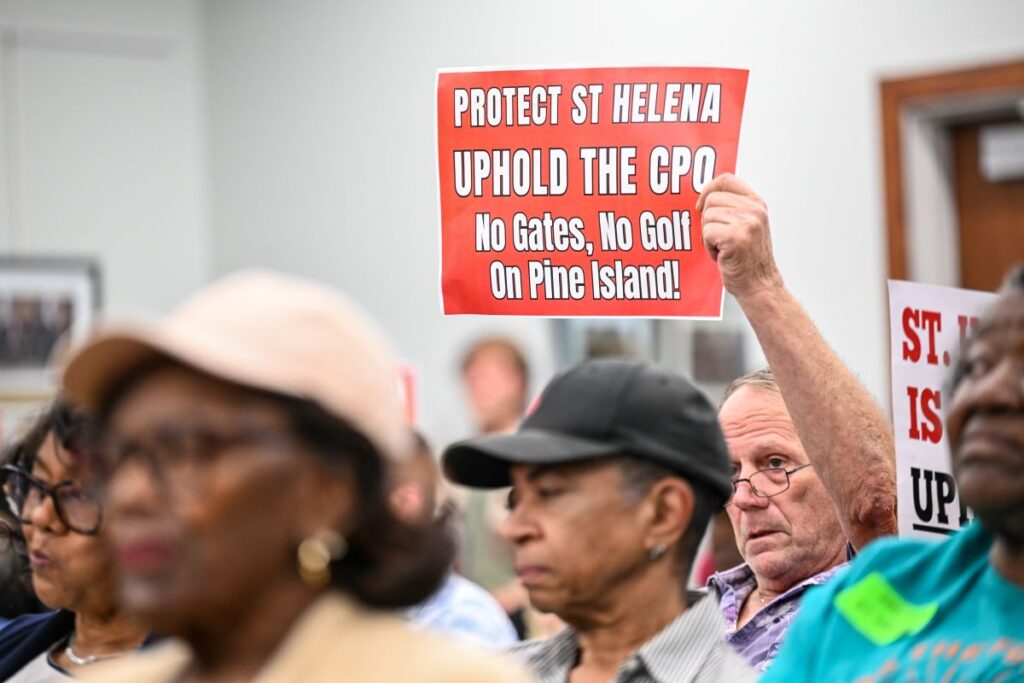
In what has become an oft-repeated scene, opponents and proponents of a proposed golf resort on the St. Helena Island property commonly referred to as Pine Island once again slugged it out Monday, Nov. 9, in a marathon session in front of Beaufort County Council.
At issue was a request to change the zoning on the property, removing the 502-acre property from the boundaries of the St. Helena Cultural Protection Overlay. The overlay prohibits the development of golf courses, resorts and gated communities within its boundaries.
If approved, the change would clear a major obstacle to a proposed golf resort. While the zoning change request itself made no mention of any future plans for the property, the property owners’ intentions have been unambiguous in court filings.
“From the initial acquisition through present, Plaintiffs’ objective has remained an 18-hole golf course-centered development with limited residential density,” wrote attorney Ellis Lesemann in an April 2026 court filing on behalf of the property owners, Pine Island Property Holdings LLC and Pine Island GC LLC.
The request treads on well-worn ground. The property owners, represented locally by developer Elvio Tropeano and Beaufort attorney Kevin Dukes, have made substantially similar requests on three prior occasions.
“The members of our county council are all pretty familiar with the applicant’s proposal since 2023,” said Council Chair Alice Howard.

The first was withdrawn shortly after it was submitted in late 2022. The following year, a similar zoning change was denied by council by an 8-2 vote. In September 2025, a new request went before council, but was hastily withdrawn minutes before council was set to vote on it.
As the latest zoning change application, filed in September 2026, worked its way through the process, county staff, the Planning Commission and the Natural Resources Committee all recommended that it again be denied.
During the Nov. 9 meeting, Dukes and Tropeano addressed council, making arguments that were substantively the same as they made in recent weeks to the Planning Commission and the Natural Resources Committee with one notable change.
Tropeano revealed an offer made to council to settle a lawsuit that the property owners brought against the county related to a past zoning application denial. That offer was, ostensibly, contingent upon the county’s approval of the current rezoning application.
The settlement offer was discussed behind closed doors in executive session prior to the start of the regular council meeting. Tropeano brought the offer forward into the public view.
In it, he promised: a $3.5 million donation to the Beaufort-Jasper Housing Trust to support workforce housing initiatives; to pay the county’s legal bills of $343,619 related to Pine Island matter; to reduce the total number of docks for the planned development to 14 and to install an advanced wastewater treatment facilities to service the planned development.
“This council and county is at a significant turning point where you guys can effectuate positive change for your constituents in a manner candidly unlike any other council has been able to before,” Tropeano said.

Some 30 members of the public commented on a proposed ordinance to approve the zoning change. A proposed ordinance requires three readings and a public hearing before it can be adopted. A denial at any stage kills the effort. The Nov. 9 meeting was the ordinance’s first reading and its public hearing.
In a change from the September 2025 public hearing, when speakers had an unlimited amount of time and the meeting lasted until the early hours of the following day, speakers were limited to five minutes. Still, it was 11 p.m. before each member of the public who wished to speak had their say.
A clear majority of the commenters, like Okatie resident Anne Clark, spoke in opposition to the proposal.
“St. Helena’s protections were not written by accident. They were written by families who have held this land for generations, people who have seen what happens when someone with more money decides your home would make a nice playground for someone else. Those rules are not an obstacle. They are a promise, and this county kept that promise.”
Before the debate shifted back to council, Tropeano urged council to approve the first reading and move the matter onto the second reading, arguing that the executive session had ended before all of the details regarding the settlement offer could be discussed.
“I would urge this council to receive that legal advice and take whatever steps necessary to ensure that this decision is made in the best interest of all taxpayers,” Tropeano said.
Opening council debate, Council member Logan Cunningham made a motion to delay the vote on the rezoning ordinance until the full details of the settlement offer could be considered. That motion failed by a 6-4 vote and he quickly followed with a motion to approve the first reading of the rezoning ordinance.
When the rubber hit the road, the motion to approve the rezoning failed by a 7-3 vote. Voting to approve the ordinance were Cunningham along with council members Paula Brown and Tom Reitz.
Council member Joe Passiment then put forward a motion to deny the application, which passed with the same three council members now opposing the motion.
County Attorney Brian Hulbert explained the reason for the second vote, saying, “The preferred action is to have affirmative action concluding one way or another rather than just having it fail on a vote. From here, I expect that we will be in litigation.”
Council returned to executive session, emerging a few minutes later with a motion to reject the Pine Island settlement offer. It passed by a 7-3 vote, again with Cunningham, Brown and Reitz dissenting.\Jessie White, senior attorney with the South Carolina Environmental Law Project, has opposed rezoning Pine Island since the first request was floated four years ago.
Reflecting on the recent vote, she said, “What was on display last night was true community power. That’s why St. Helena created the CPO. That’s why St. Helena is defending the CPO. They’re going to continue to do so because they know this place is special and worth protecting.”
With the denial of the rezoning application, the property owners must wait one year before they can try again. Arguments in another Pine Island lawsuit pending in the Fourth Circuit Court of Appeals are scheduled to be heard early next month in Richmond, Va.
You can reach Tony Kukulich at tony.theislandnews@gmail.com or at 854-257-8125.