
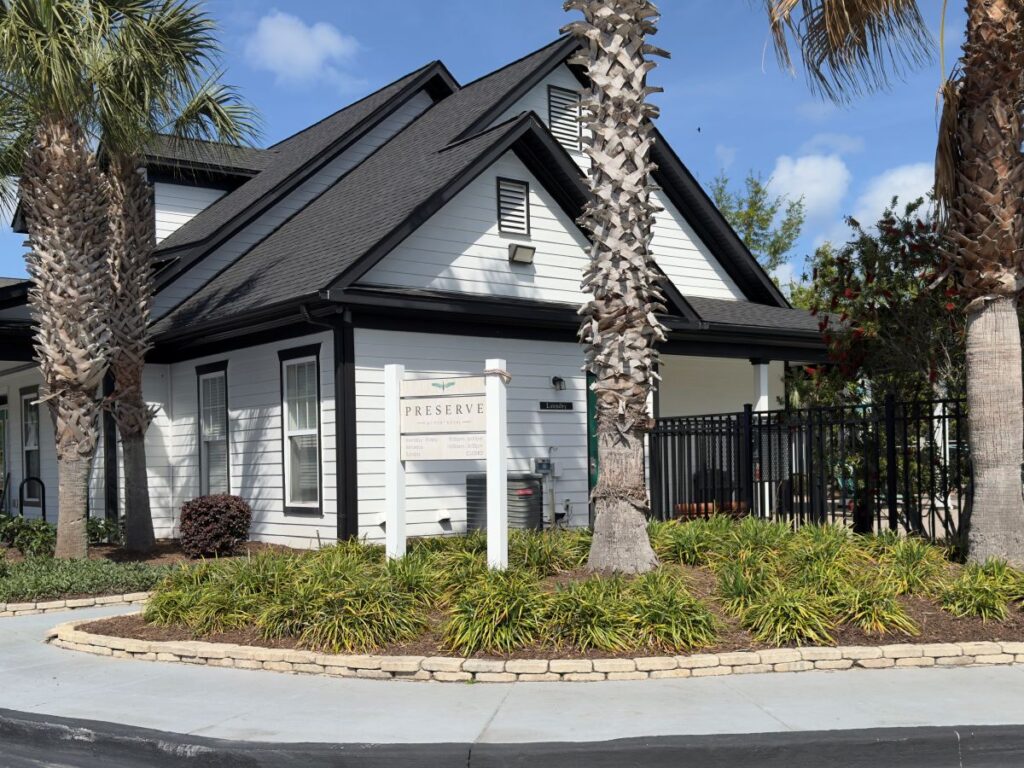
Development avoids property taxes while claiming affordable housing status
By Delayna Earley
The Island News
The Town of Port Royal didn’t learn about a $1.3 million tax loss from a report. It found out on social media.
“Ding, ding, ding, ding. Lights go off,” Town Manager Van Willis said.
That moment, sparked by a post questioning how the Preserve at Port Royal’s tax bill dropped from more than $1.3 million to just a few thousand dollars, led town officials to uncover what they now describe as a loophole in state law.
The loophole allowed a private apartment complex to avoid paying property taxes while claiming to provide affordable housing.
A tax bill that disappeared
Just last year, the Preserve, a 400-unit apartment complex in the center of Port Royal, paid more than $1.34 million in property taxes.
This year, it is expected to pay none.
The result is a loss of about $349,000 to the town, roughly 6% of its $11 million budget. More than $700,000 in funding for the Beaufort County School District is also affected.
“For us, losing that kind of revenue is significant,” Willis said. “My budget is only $11 million.”
How it happened
According to Willis, the exemption stems from a section of South Carolina law that allows companies to carve out a small portion of their corporate structure under the premise of providing low- to moderate-income housing.
In the case of the Preserve, that portion is just 0.1%.
“They have set aside 0.1% of their ownership structure, which has now enabled them to exempt $1.345 million in property taxes,” Willis said.
The property is owned by Sundance Bay, a Utah-based private equity firm with roughly $4 billion in assets.
Despite the scale of the development, which sold for $92 million, the exemption means it now contributes nothing in property taxes.
“That $6,000 people are seeing is stormwater fees,” Willis said. “They paid nothing in property taxes.”
A discovery after the fact
The timing made the impact worse.
Willis said the exemption was finalized in May 2025, after the county had already provided the numbers Port Royal uses to build its budget.
The town adopted its budget in June 2025 expecting that revenue to be there.
Emails between the county’s chief financial officer and auditor show the exemption was included on a list provided by the South Carolina Department of Revenue on May 30, 2025, during the height of local budget planning. There was no direct notification to the town about the loss of one of its largest revenue sources.
“I don’t want to cast aspersions,” Willis said, “but nobody notified us about a $1.3 million exemption.”
It was not until months later, while reviewing lagging revenue, that the town realized something was wrong.
The issue was discussed publicly during the Port Royal Town Council workshop on April 1, 2026, where officials walked through how the exemption was discovered and what it could mean moving forward.
Council members said the lack of notice left them working with incomplete information.
“We’re making decisions based on numbers that weren’t accurate,” councilman Jorge Guerrero said.
“It’s a mess”
Mayor Kevin Phillips said the issue goes beyond one apartment complex.
“It’s a mess,” he said. “You’ve got an out-of-state private equity firm taking advantage of a South Carolina law and really hurting the citizens of Beaufort County as a whole.”
Phillips said the loss affects the town’s most basic services.
“Almost 80% of our budget is police, fire and public works,” he said. “That’s quality of life. That’s who this hurts.”
He also questioned how the exemption was granted in the first place.
“Every single property owner in Beaufort County now pays more in property taxes than this corporation,” Phillips said. “This is a Utah-based private equity firm with about $4 billion in assets. If you look at their website, it’s about maximizing growth. You don’t see anything about nonprofit work or affordable housing. They are taking advantage of how the law is written, and nobody is stopping it.”
The affordability question
At the center of the issue is whether the Preserve is providing affordable housing. Town officials say there is little evidence that it is.
During the council discussion, Willis said a firefighter earning about $48,000 a year contacted the complex to ask about an affordable unit. He was quoted about $1,450 for a one-bedroom apartment.
That would require roughly 36% to 38% of his income, well above the standard definition of affordability.
“He said, ‘No, I want one of the affordable ones,’” Willis said. “And they said, ‘We don’t have any.’”
Council members said the lack of transparency makes it difficult to determine whether the development meets the requirements for affordable housing.
“We don’t know,” Willis said. “We can’t prove it or disprove it.”
Officials also noted that key financial and tenant data tied to the exemption application has been redacted in public records.
A loophole with broader impact
Town leaders say the structure used by the Preserve could spread if the law is not addressed.
“What’s scary about this is this could spread like wildfire,” Willis said. “Municipalities, counties, fire departments and police departments could be hit hard by this loss of revenue.”
Phillips said the burden ultimately shifts to local residents.
“We want businesses to succeed,” he said. “But when that success comes at the expense of the people providing the core services in our community, that’s when we have a problem.”
What happens next
Port Royal officials are working with state lawmakers to address the issue, though they have been told any fix may not apply retroactively.
If that happens, the Preserve could remain tax exempt indefinitely.
In the meantime, the town is working to close a budget gap it did not know existed.
“This has kept me sleepless at night,” Willis said.
Delayna Earley, who joined The Island News in 2022, formerly worked as a photojournalist for The Island Packet/The Beaufort Gazette, as well as newspapers in Indiana and Virginia. She can be reached at delayna.theislandnews@gmail.com.