
By Luke Frazier
Special to The Island News
LADY’S ISLAND
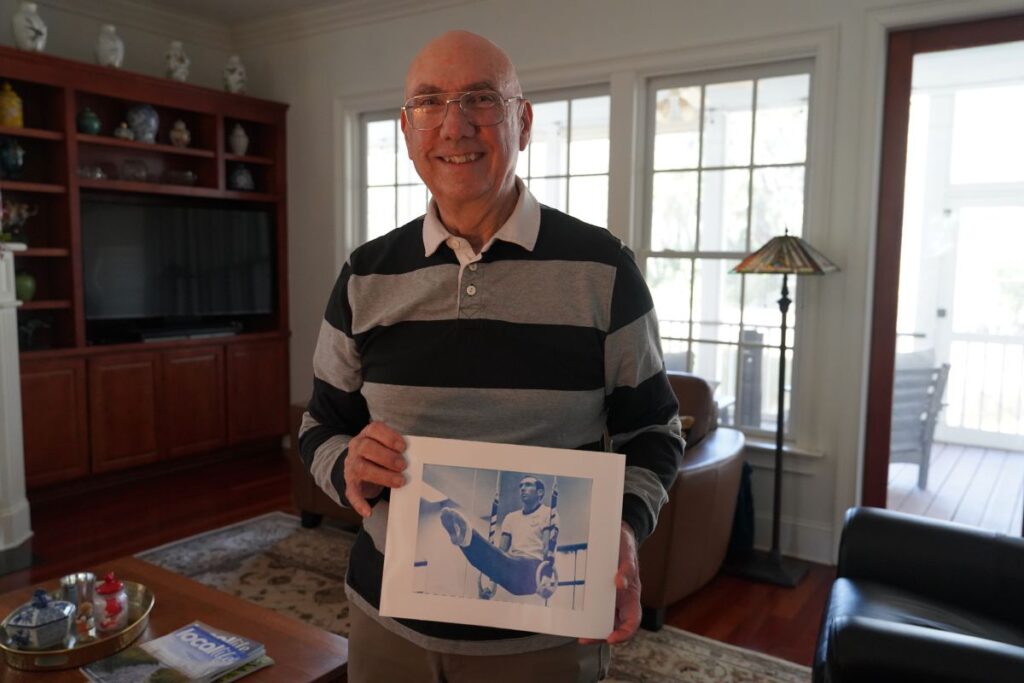
George Greenfield sits comfortably in his Lady’s Island home overlooking a pond where blue herons visit daily as he thinks back to the warm day of Aug. 26, 1972. He was one of the 400 U.S. athletes marching into the Olympiastadion in Munich for opening ceremonies of that summer’s Olympics.
He remembers wearing a wide tie of red, white, and blue (as early 70s fashion dictated) and pair of black and white patent leather shoes as part of his outfit.
“It took about two hours to get into the stadium just to do the lap,” George recalls, “and then you get to the place they designated for you to stand for the next two hours.”
The ceremonies included the Olympic pledge, the lighting of the torch, and plenty of pomp and circumstance. There was absolutely no other place on earth he would rather have been that day.
“It was just the most exciting environment in the world,” Greenfield said, “and one of the reasons the Olympics is so big is that it’s the only venue that brings all the sports together.”
Greenfield also shares some memorabilia from the day: the Olympic ring belt buckle, now smartly mounted on marble, and the captivating commemorative ruby ring.
Greenfield is among the tiny percentage of U.S. male gymnasts who ever make it to the Olympics, and he knew he was going to go to Munich after sticking the landing in his final horizontal bar routine at the men’s trials two months before.
He said that feeling was incredible, and the video from the broadcast on ABC’s Wide World of Sports program he shares 54 years later confirms both the perfect landing and the huge smile on his face.
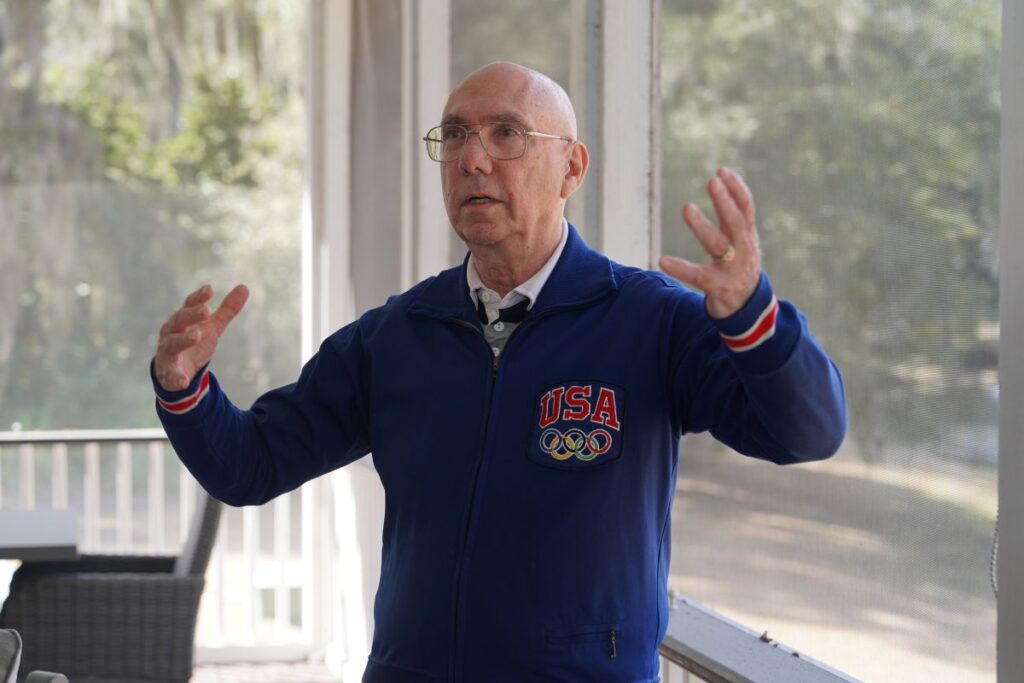
His Olympic journey began in earnest four years before that on the day the 1968 games in Mexico City ended. He sat with his coach and cracked open a blue spiral notebook to the last page. On it he wrote, “1972, make the U.S. Olympic Team.”
Then he and the coach proceeded to write down all the steps that needed to take place in the years before then to make it a reality, including national and international competitions and training regimes. Greenfield hit all the marks and made the team.
In Munich, the bubble burst a bit. Greenfield and the U.S. team underperformed.
“It was frustrating because we had worked so hard,” George reflects, “and the nerves kind of got to me and the whole team didn’t do really well and placed 10th … we didn’t live up to our possibilities.”
All that concern disappeared in the face of the grim reality that soon erupted next door to the American compound on September 5.
“The night after we finished, the terrorists came into the Israeli compound,” George said, “which we could throw a baseball and hit their building, but we knew nothing about what was happening.”
The next morning, U.S. officials heard rumors about shots fired in the Olympic village, but details were nonexistent. All Greenfield and other U.S. athletes were told is that security was going to be tighter and if they were leaving the village, be sure and take their identification badges. Greenfield went on a planned day trip to tour Bavarian Castles.
When he returned to the village around 6:30 p.m. it was cordoned off by German military and police. Greenfield finally heard what was happening from a news report on the radio that someone had been playing in his compound.
Meanwhile, back in the U.S., his fiancé (now long-time wife) Gail had already known what was happening via television broadcasts.
“And I remember when that happened,” Gail Greenfield somberly recalls, “We had just gotten engaged and I thought ‘there goes my future.’ I mean, it was scary.”
The world was shocked as the chaos of hostages, failed negotiations, late-night helicopter flights and armed standoffs unfolded over the next two days. Eventually the battle resulted in the deaths of all hostages and many terrorists. Brutal reality smashed the hope of cooperative competition into the blood-stained tarmac.
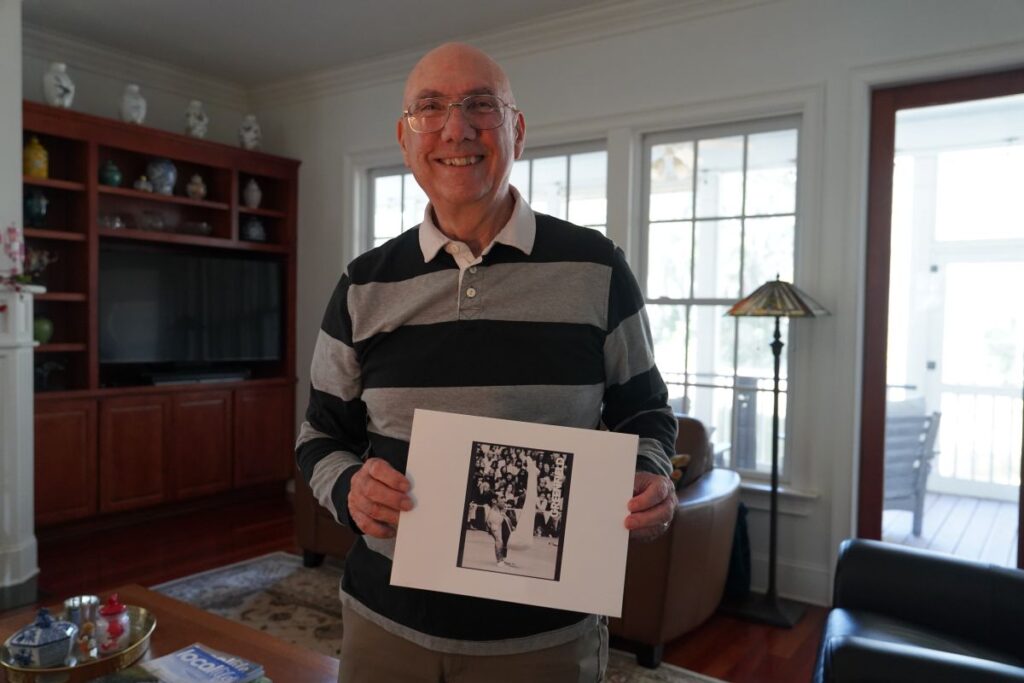
The Olympics paused for 34 hours. George Greenfield attended the memorial service in the same stadium that was filled with celebration just days before, then flew back home.
Now, almost 5,000 miles away and decades later, George Greenfield is asked about his views concerning politics and the Olympics, a subject relevant in this Olympic year. A Ukrainian athlete was recently disqualified from the 2026 Winter Olympics in Milano Cortina [Italy] for refusing to replace his skeleton sledding helmet that was adorned with pictures of athletes and coaches killed in the ongoing war with Russia.
George says that it’s difficult when political statements get in the way of pure competition but acknowledges, “This is a really difficult question … we all have very strong opinions. It’s a two-sided coin [because] I believe that one of the strengths that we have in the world is the ability to speak our opinion.”
On the other hand George Greenfield feels strongly that the Olympics are intended to bring people together and affirm harmony and political neutrality. He wonders about a suggestion that there be some middle ground in allowing political statements.
“Yeah, I think they could create a place on the uniform for statements,” George says, “But even then, making a statement is going to be bigger [than a patch], so how do you even manage that?”
At this point in his life George Greenfield is OK with letting his opinion remain incomplete. He knows it’s a thorny and complex issue, “but I look at it through my rose-colored glasses and try and just look at the athleticism.”
Instead of this seeming like an excuse, sitting with George Greenfield as he reflects on his Olympic career and the issue of politics is a lesson in humility. He is a deeply grateful man who feels lucky to have been part of an elite level of athletics. He also loves his family and doesn’t take his good fortune for granted.
“The Olympics has opened a lot of doors for me,” he says, “my first job out of school, my interviewing manager was more interested in my athletic career than my business capabilities. Because of the doors that were opened, I had a really great career, which has funded us being here, which we love.”
On this day of beautiful sunshine in the Lowcountry, that sentiment is more than enough to earn the gold.
Luke Frazier is a writer and award-winning media producer who moved to the Lowcountry in 2024. He runs NOW Communications and can be reached at nowandfuturecomms@gmail.com.