By Delayna Earley
The Island News
State environmental officials and representatives of Coastal Waste and Recycling met with Lady’s Island residents Monday night, Jan. 26, at Coosa Elementary School to explain operations at the construction and demolition landfill on Third Point Road, review air-monitoring data and respond to ongoing odor complaints residents say have worsened in recent years.
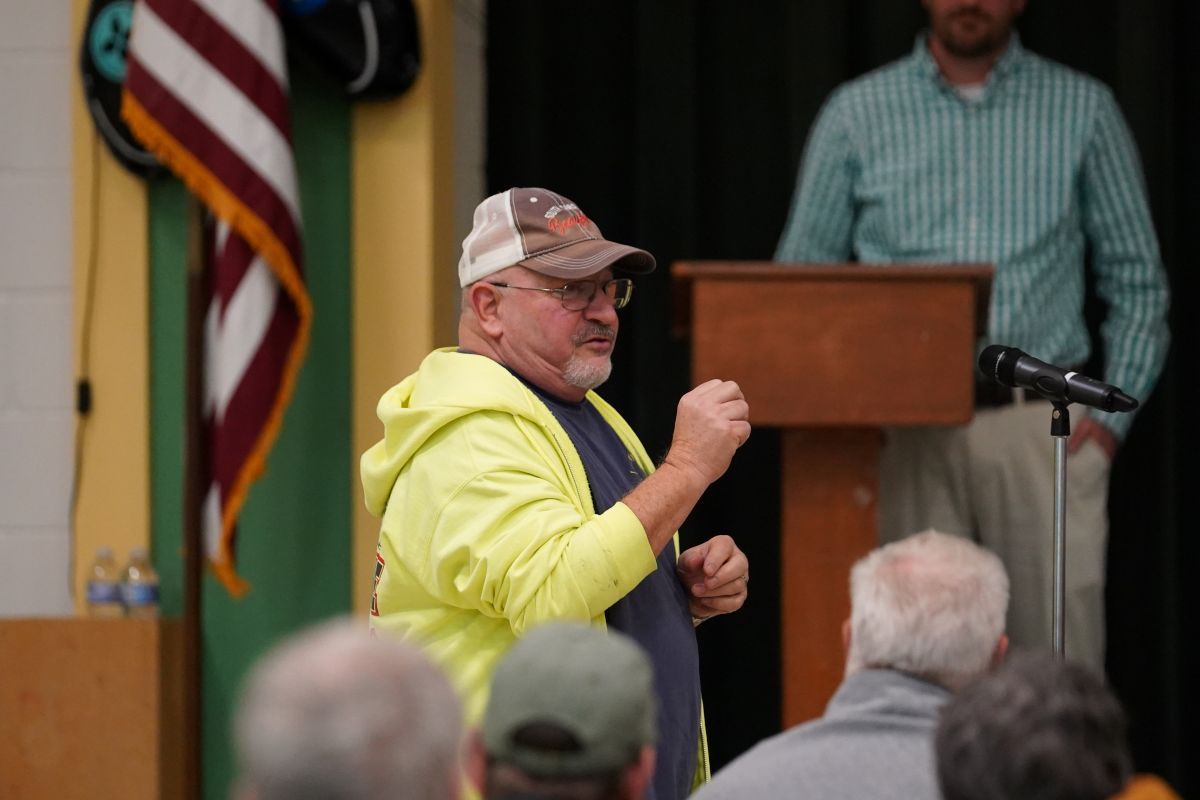
The meeting drew a large turnout and, at times, tense exchanges as residents pressed for clearer timelines, stronger enforcement and a faster, larger-scale response to what many described as a quality-of-life crisis — not simply an inconvenience.
“They’re calling it an odor — it’s not just an odor,” one resident said during the meeting. “We’re having visible ailments. We’re having respiratory problems. Our dogs are having problems.”
A multi-agency response, officials say
“This is a really important night for us,” said Kristy Ellenberg with the South Carolina Department of Environmental Services. Ellenberg noted the agency is still widely referred to by residents by its former name, the Department of Health and Environmental Control.
She said multiple divisions are involved in the response, including air quality, waste management, science services and regional environmental services.
Ellenberg said resident-submitted odor reports have helped shape where monitoring is occurring and how trends are being evaluated.
“The information you’re providing has been really helpful,” she said. “It’s helped us look at where we should be monitoring and whether there’s a correlation between weather, landfill operations and where odors are being noticed.”
Facility background and permitted capacity
The landfill, located at 499 Third Point Road, is permitted as a Class II construction and demolition debris landfill. State officials said it has a permitted footprint of about 57 acres and an overall permitted disposal volume of approximately 3.4 million cubic yards, with about 2.4 million cubic yards remaining.
Based on the permitted annual disposal rate of 156,000 tons per year, officials said the landfill has an estimated remaining life of about 16 years. They noted the estimate may vary depending on annual disposal volumes.
The site was originally permitted in 1988 and has undergone several expansions and ownership changes over the decades. Coastal Waste and Recycling became the current owner in 2023.
Materials accepted at the landfill include construction and demolition debris such as concrete, asphalt, bricks and drywall, as well as land-clearing debris, wood, mattresses, box springs, shingles and packaging materials, officials said.
Why odors occur — and why weather matters
Officials said odors reported by residents are primarily associated with hydrogen sulfide gas, which can form when certain materials — particularly drywall — become saturated and break down under anaerobic conditions.
“It’s not necessarily the incoming waste,” a state official said. “The issue develops when materials become saturated and conditions allow hydrogen sulfide to form.”
Water management was repeatedly emphasized as a key factor in odor prevention. Landfills are required to maintain drainage and apply cover material at prescribed intervals, officials said, and facilities must be designed to manage stormwater runoff from major rain events.
Sensors, weekly reports and inversions
Connie Turner with the agency’s science services team outlined hydrogen sulfide monitoring now underway.
Two sensors — one at the landfill and one in the surrounding community — operate 24 hours a day, seven days a week. Turner said the devices are qualitative tools used to identify trends and inform the investigation, not to establish regulatory compliance.
“These are qualitative tools,” Turner said.
Readings are measured in parts per billion — a very small unit — but hydrogen sulfide can be detected by smell at low concentrations, she said.
Weekly public reports combine sensor data with meteorological information, including temperature, dew point and wind conditions. Turner said staff review data using 24-hour time-weighted averages to compare trends consistently across a week.
Odor reports often increase during calm conditions and atmospheric inversions, when temperature and dew point move closer together and odors can linger near the ground, Turner said. Strong winds tend to disperse odors more quickly.
Health concerns raised; officials urge medical consultation
Residents described headaches, respiratory irritation and other symptoms they believe are associated with odors from the landfill.
Ray Fulberger, an environmental risk specialist with the agency, said he is not a physician and encouraged residents with health concerns to seek medical attention.
Fulberger said the highest readings detected on local sensors have been in the hundreds of parts per billion — well below occupational exposure thresholds — while acknowledging hydrogen sulfide has a very low odor threshold and can be unpleasant or irritating even at low levels.
Residents also asked about mold. Officials said mold is generally considered an indoor air issue and is not typically monitored outdoors as part of landfill air assessments.
Company vows improvements; gas system under assessment
Chad Abel, representing Coastal Waste and Recycling, told residents responsibility for improving conditions at the landfill rests with the company and with him personally.
“It is my responsibility to ensure that this landfill improves its current conditions,” Abel said.
Abel said operations and staffing have not fundamentally changed under current ownership, pointing instead to rainfall, older buried material and anaerobic conditions as contributing factors.
The company is prioritizing work on the landfill’s top deck, he said, placing new waste over older material and installing final soil caps designed to shed water and reduce saturation.
“As long as you’re shedding water, that’s what really matters,” Abel said.
Abel acknowledged he cannot promise odors will never occur but said the goal is to significantly reduce them.
“I will not tell you there will never be an issue,” he said. “We are going to put the best management practices in place so that if there is a smell, it comes and goes quickly.”
He said the company is assessing whether a gas collection system could work at the site and has installed test wells to analyze gas composition.
“I can’t tell you today that a gas collection system will work,” Abel said. “I need the data.”
Groundwater, runoff and erosion questions
Residents asked whether the landfill has a liner and how groundwater is protected.
State officials said the landfill does not have a liner membrane, noting one is not required by regulation for this type of facility. However, officials said the site is subject to quarterly groundwater monitoring, with results submitted to the state for review.
Concerns were also raised about erosion, slope stability and stormwater runoff near areas where residents reported seeing washouts or exposed material. Officials said exposed areas are repaired when identified and that drainage patterns and surface-water controls are being reviewed, with some improvements considered longer-term measures.
Truck traffic, waste volume and inspection process
Residents also pressed officials on truck traffic, with several describing what they said is a noticeable increase in heavy trucks traveling to and from the landfill, including early-morning and nighttime hours.
State and landfill officials said the total volume of waste entering the landfill has remained relatively consistent in recent years, with disposal volumes over the past five years showing no significant increase.
Officials said about 75% of the waste received at the landfill comes through a transfer station off Boyd Road. Material is unloaded and inspected at the transfer station before being reloaded onto larger trucks for transport to Lady’s Island, then inspected again upon arrival. Employees at both locations are trained to identify and remove prohibited materials, officials said.
Landfill representatives said the facility’s permitted annual disposal rate has not changed and that no increase in allowable tonnage or truck routes has been approved.
Enforcement process and calls for urgency
Residents questioned why stronger directives have not been issued and urged state officials and elected leaders to respond more forcefully.
State officials said the landfill is inspected at least monthly. If violations are identified and not corrected within required time frames, enforcement actions can be taken. Officials said that step has not been triggered because issues identified during inspections have been addressed.
Julie Blaylock, chief of the Bureau of Land and Waste Management, acknowledged residents’ frustration and said conditions at the landfill have changed over time as the site has expanded vertically.
“When the landfill was 20- or 30-feet tall, it was easier for saturated material to dry out,” Blaylock said. “Now the waste mass is much deeper, and it takes longer.”
She said hydrogen sulfide odor issues often require a step-by-step approach influenced by weather, waste composition and site design.
“I know you don’t want to hear that it won’t be solved tomorrow,” Blaylock said. “It took time to get this way, and it’s going to take some time to resolve.”
Several residents called for the landfill to stop accepting waste until odors are controlled. Officials responded that new waste itself is not considered the primary source of hydrogen sulfide and that covering older material is part of the mitigation strategy, though they acknowledged extreme rainfall events complicate management.
What’s next?
State officials said inspections, monitoring and weekly public reporting will continue and that resident reports remain central to tracking whether mitigation efforts are working.
“Our goal is to strengthen those connections,” Ellenberg said. “To share what we know, answer what we can, and talk about the path forward.”
Delayna Earley, who joined The Island News in 2022, formerly worked as a photojournalist for The Island Packet/The Beaufort Gazette, as well as newspapers in Indiana and Virginia. She can be reached at delayna.theislandnews@gmail.com.